Deutsch
  Español
  Français
  العربية
  Indonesia
  Italiano
  한국어
한국어  Nederlands
  Polski
  Português
  Türkçe
  简体中文
简体中文  ไทย
ไทย  Tiếng Việt
  Čeština
  فارسی
فارسی  Română
  Filipino
  日本語
日本語 


Internet by ID: Countries With Age Verification Laws in 2026 (Full Map)
You open one of your favorite websites and an age-verification screen appears: enter your date of birth, scan a government ID, or take a selfie to verify your age. Some services may ask you to verify your age through your mobile carrier or bank instead. But what’s the reason behind this?
 Fawad Ali


 Quick Navigation
All over the world, governments are changing age verification laws, and in 2026, these rules are affecting how people access certain websites and online services. They can require websites, social media apps, and gaming platforms to verify your age before giving you access. So what happens when a website asks how old you are, and is it safe to answer?
What is online age verification?
First, let’s sort out the essentials.
Age assurance is a wide term that covers various approaches to checking a person’s age. For many years, it was all covered with simple age confirmation. A checkbox or date-of-birth field appeared on a website, asking you to fill in your information. At the same time, the system wasn’t able to tell whether users were telling the truth.
Today, things are different. A more sophisticated approach is age verification, the method that doesn’t simply take your word for it. Instead, the system uses more advanced ways to check your age, such as uploading a passport, scanning your face for AI age estimation, or using a legitimate digital ID.
Now, what’s the actual difference? It’s between proving that you’re old enough to access certain content and giving away your full identity. And that’s exactly where privacy enthusiasts tend to raise their eyebrows.
The thing is, age verification systems function differently. While some apply a one-time identification tied to a device, others keep verifying you once a new session begins. Some are tied to a specific platform, and others turn to third-party providers (which means your personal data may eventually end up on an entirely different website or platform).
Why are governments doing this in 2026?
Lawmakers have understood that self-declared age verification doesn’t keep minors away from adult or dangerous content, from pornography to gambling and adult-oriented social media sites. Obviously, they needed a way to limit kids’ access to those kinds of websites and platforms.
To cut a long story short, here are the key reasons why governments apply more severe age verification rules:
- To keep minors away from adult content
- To reduce kids’ exposure to harmful online material
- To restrict access to age-gated services
- To hold platforms accountable for the content they provide
While from a certain perspective this certainly makes sense, privacy advocates and digital rights groups point at the downsides of this approach. Age verification comes with personal data exposure, putting people’s online privacy at risk.
When giving away the information about your date of birth (often accompanied by ID or even real documents, such as a passport), you never know who can get their hands on this data. Nobody wants their sensitive info to end up in the hands of a hacker or somewhere in the dark web, after all.
The global map: Age verification laws in 2026
Age verification laws vary around the world. Each country (or sometimes even state) may have its own regulations. Let’s look at some of the most significant examples as of 2026, but keep in mind that this area tends to change pretty quickly.
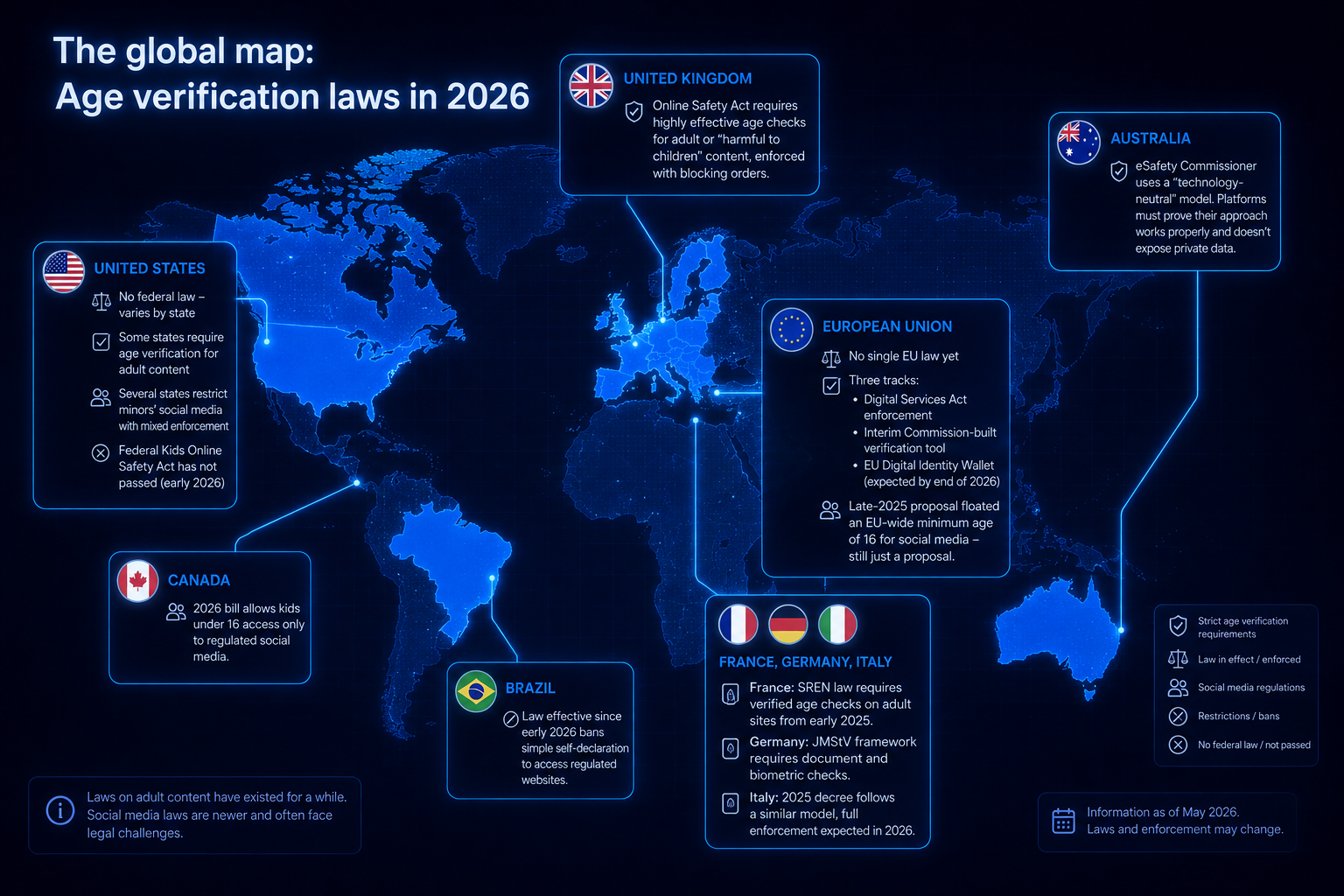
The United Kingdom. The UK is among the strictest in terms of its age verification policy. According to the Online Safety Act, websites hosting adult or “harmful to children” content have to use highly effective age checks enforced with blocking orders.
Australia. The eSafety Commissioner uses a “technology-neutral” model. This means that while there’s no specific verification method required, platforms must prove their approach works properly and doesn’t expose private data. The under-16 social media ban itself has been in force since 10.12.2025, with platforms facing fines of up to AUD 49.5 million for systemic non-compliance.
The United States. The US doesn’t have a federal law regulating age verification. It varies from state to state. Louisiana, Utah, Texas, Arkansas, and several other states require verification for adult content. In contrast, some separately restrict minors’ social media with mixed enforcement. Virginia and Nebraska have had social-media laws since 2026 (however, both were immediately blocked in court). Florida, Georgia, and New York have passed laws that still encounter certain legal challenges. Finally, the federal Kids Online Safety Act hasn’t passed as of early 2026.
European Union. There’s no single EU law yet. Instead, there are three possible tracks: Digital Services Act enforcement, an interim Commission-built verification tool, and the EU Digital Identity Wallet (expected by the end of 2026). A late-2025 proposal floated an EU-wide minimum age of 16 for social media. But for now, it’s still just a proposal.
France, Germany, Italy. France’s SREN law requires verified age checks on adult sites from early 2025. Germany’s JMStV framework requires document and biometric checks. Italy’s 2025 decree follows a similar model and has been in force since November 2025.
Canada. Canada introduced a bill in June 2026 (Bill C-34, the Safe Social Media Act) that would ban children under 16 from holding accounts on regulated social media platforms.
Brazil. Brazil’s law, effective since early 2026, bans simple self-declaration to access regulated websites.
Asia-Pacific. Several countries in the region have introduced stricter age requirements for online platforms. In Malaysia, new age-verification requirements for social media platforms took effect on June 1, 2026, with a minimum age of 16. Indonesia has also begun enforcing PP TUNAS, which restricts access to certain high-risk digital platforms for users under 16.
It’s important to note that while laws related to adult content have already been in force for a while, the ones regulating access to social media platforms are relatively new and frequently challenged in court.
How does age verification actually work?
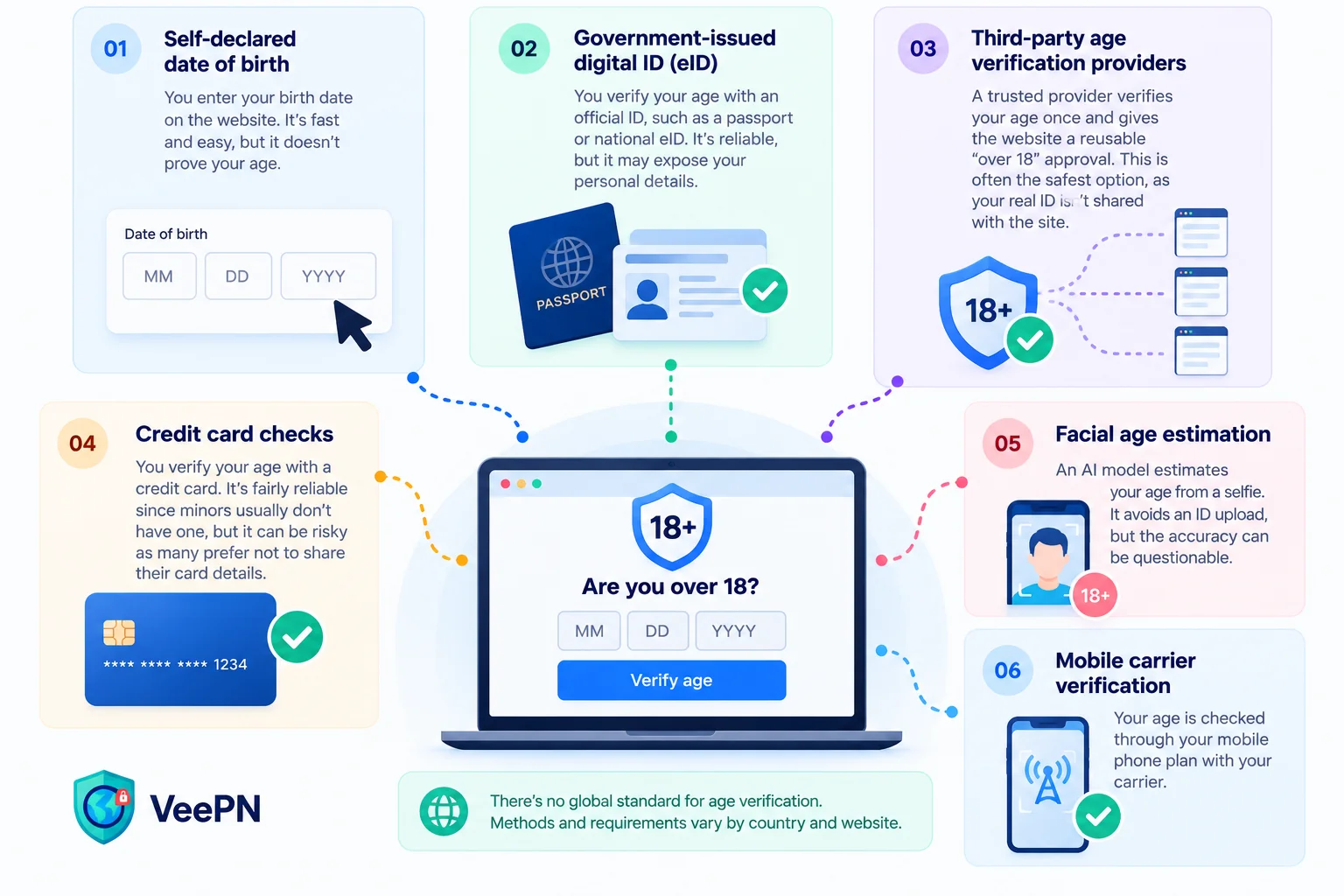
Here are the most common methods most websites apply to verify users’ age:
- Self-declared date of birth. While this method is fast, it proves nothing. Despite this, it’s still the most widespread approach.
- Government-issued digital ID (eID). This approach is reliable, but it ties your identity to the platform (unless designed otherwise), and your private details might get exposed.
- Third-party age verification providers. A website checks your age once and issues a reusable “yes, over 18” approval. Since the site never sees your real ID, this method is the safest (as long as the provider is reliable).
- Credit card checks. While this approach is pretty solid since minors aren’t likely to hold one, it’s imperfect and risky. Many wouldn’t give away their card details without convincing security measures.
- Facial age estimation. Modern AI models can estimate age based on a photo. Although they avoid an ID upload, their accuracy can be questionable.
- Mobile carrier verification. This method allows websites to check your age through your current phone plan.
None of these methods has become the global standard. And, since the policies vary globally, it will likely remain this way for a while.
What changes for you as a regular user
The effect of age verification on websites might affect your online experience differently, depending on your location. For example, in the UK, websites and apps that allow pornography have been required to use highly effective age assurance since July 25, 2025. Other services may also use age checks to protect children from harmful content. Meanwhile, in the US, your experience on the same website may be entirely different depending on which state you’re in.
Finally, if you’re traveling, a website you’re used to visiting without any friction may suddenly require additional steps to verify your age or even ask for an ID scan. This can happen because age verification requirements vary by country and, in some cases, by state.
The privacy debate
The problem here is pretty obvious. While some websites only need to know whether you’re over 18, they tend to require much more personal information. But once you upload a passport, provide your digital ID, or give your credit card details, your data might become exposed. This isn’t hypothetical. In 2025, a breach involving a third-party customer service provider used by Discord potentially exposed government-ID photos belonging to around 70,000 users. The IDs had been submitted for age-related appeals, showing how sensitive information collected for age checks can become exposed if a third party is compromised.
Naturally, those who care about their digital privacy want to know where this info is stored, how long a website keeps it, and who else can access it (for example, in case of a breach).
At the moment, privacy-friendly age verification is an important matter that should be discussed and considered by both government laws and service providers. There are a couple of good examples, such as the EU’s digital identity wallet. Several providers also let users confirm their age without asking about more confidential details.
So, what can you do to protect yourself from exposing your personal info when verifying your age? Here are a couple of relevant tips:
- Don’t give away any personal details, including your passport, ID, or banking credentials, on websites that look fishy.
- Don’t click on suspicious links.
- Use strong passwords across all your accounts.
- Use a strong antivirus tool like VeePN Antivirus to prevent your system from common online threats.
- Consider turning on a reliable VPN to protect your online presence.
💡 Important note: VPNs do not verify (or un-verify) your age. They also don’t let you trick any local laws. So, why are they helpful? Simply put, a VPN masks your IP address and runs your traffic through an encrypted tunnel. This way, your Internet activities are more private. Besides, you may be able to access your favorite content even when traveling to other countries.
Bottom line
Along with the risks certain online content comes with for minors, mandatory age assurance is getting more and more common around the world. Digital identity wallets, like in the EU, may become a safe alternative for unreliable or privacy-unfriendly methods. At the same time, many countries have vague laws regarding user age checks, while the ways modern systems use to follow those regulations are often imperfect.
Of course, it’s important to protect kids from irrelevant and harmful content online. On the other hand, your digital privacy is also valuable.
Need a strong tool to gain control over what websites can see about you? Keep your location, IP address, and browsing habits away from the prying eyes with a powerful VPN like VeePN.While it won’t make age-verification laws disappear, features like NetGuard and Kill Switch will add an extra security layer to your private info. Try it out today with a 30-day money-back guarantee!
FAQs
No. Most countries have their own requirements, methods, and enforcement. Some mandate ID checks, while others allow for self-declaration. Check out this article to learn more.
Not always. Some systems confirm only that you’re over 18. Others, however, may require you to reveal your name, birthdate, or even a full document scan.
It can change what location a site detects, which may affect which country’s rules apply to you when you travel. But using a VPN doesn’t cancel local laws or guarantee that an adult-oriented website won’t ask for verification.
It depends on the provider and jurisdiction. Retention rules and breach risk often vary. In particular, it’s unsafe to give away your identity on questionable websites.


VeePN is freedom
Download VeePN Client for All Platforms
Enjoy a smooth VPN experience anywhere, anytime. No matter the device you have — phone or laptop, tablet or router — VeePN’s next-gen data protection and ultra-fast speeds will cover all of them.
Download for PC Download for Mac IOS and Android App
Want secure browsing while reading this?
See the difference for yourself - Try VeePN PRO for 3-days for $1, no risk, no pressure.
Start My $1 TrialThen VeePN PRO 1-year plan