Deutsch
  Español
  Français
  العربية
  Indonesia
  Italiano
  한국어
한국어  Nederlands
  Polski
  Português
  Türkçe
  简体中文
简体中文  ไทย
ไทย  Tiếng Việt
  Čeština
  فارسی
فارسی  Română
  Filipino
  日本語
日本語 


UPS Scam Email: Don’t Let a “Delivery Problem” Empty Your Wallet
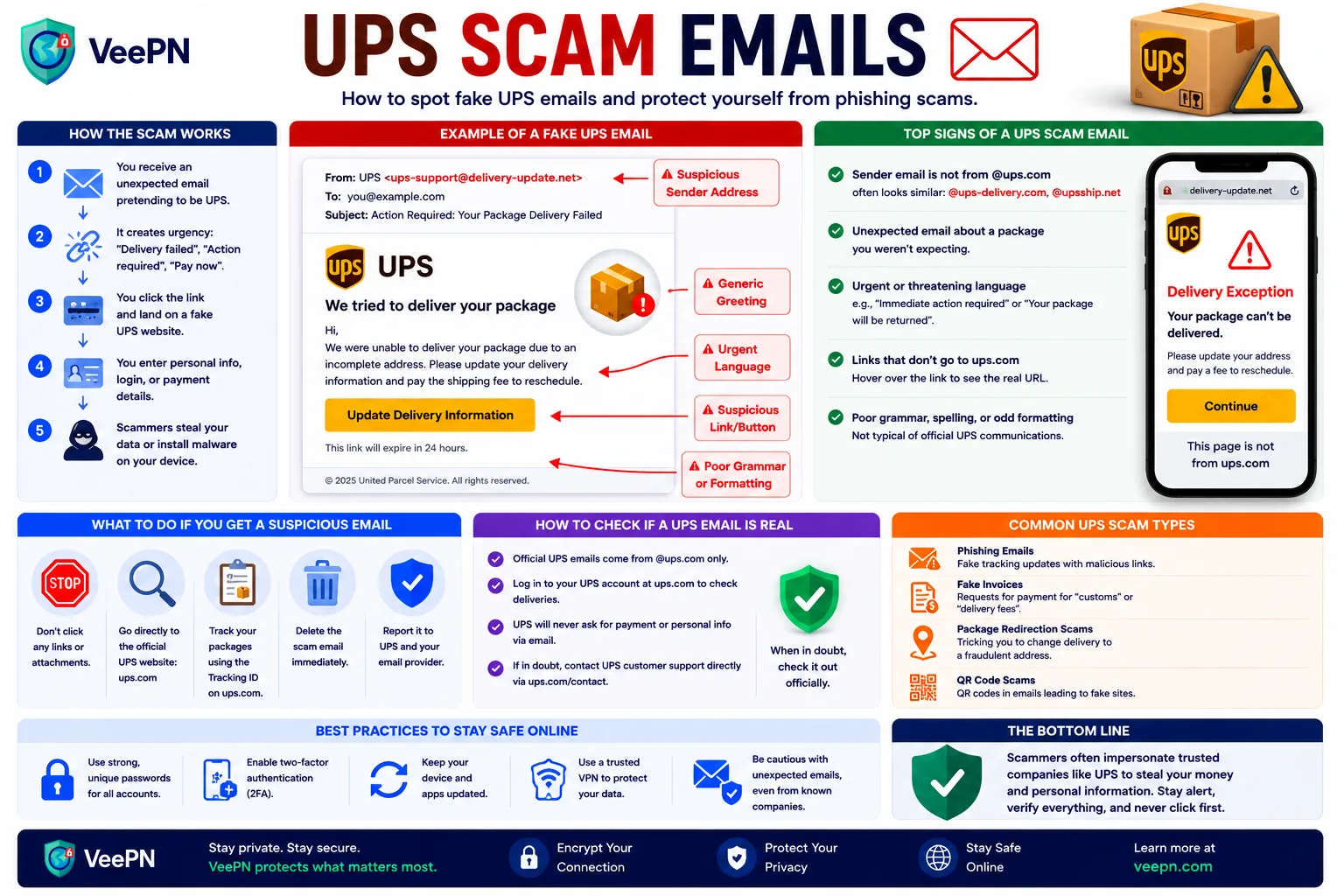
A UPS scam email usually hits when you’re busy, tired, or actually waiting on a delivery. It’s an email claiming there’s an issue with your UPS package, your package delivery, or your UPS account. The goal is simple: push us into immediate action before we think.
This guide breaks down the most common UPS scams, shows what they look like in real life, and gives clear steps to avoid fraud. We’ll also share how to verify things through the official UPS website, how to contact UPS directly, and how tools like VeePN can support better online safety later in the article.
 VeePN Research Lab

 Quick Navigation
2. Why these UPS scam messages work so often
3. The most common UPS scams beyond deliveries
4. Quick red flags that expose a fake UPS message
5. What to do if you clicked, replied, or paid
6. How to verify a UPS message and report the scam
7. How VeePN helps you avoid UPS phishing email traps
FAQ
A UPS scam email tends to land when you’re busy, tired, or actually expecting a delivery. It claims there’s a problem with your package, your delivery, or your UPS account, and the goal is always the same: push you to act before you think.
This guide breaks down the most common UPS scams, shows what they look like in real life, and gives clear steps to avoid the trap, including how to verify anything through the official UPS website and where a tool like VeePN fits in.
How a UPS scam email usually starts
Most UPS scams follow a familiar script: something is “wrong,” time is “running out,” click this link now. The FTC has repeatedly warned about fake shipping notifications that push links and payment requests.
The fake UPS delivery alert that uses fake tracking numbers
A classic fake message says your delivery is stuck and drops an official-looking tracking number. It may claim you’ll miss a delivery window unless you pay a small “fee” or “confirm details”, and that next click usually leads to a fake UPS site built to harvest payment and personal information.
What makes it convincing is timing. If you recently ordered something, you’re already expecting updates, so the scam blends in. And if you didn’t order anything, it still triggers anxiety, nobody wants a random delivery tied to their name and address.
The UPS text scam version: suspicious text messages with a malicious link
The same fraud often arrives as a text: short, urgent messages saying “address incomplete” or “delivery failed,” with a malicious link. The U.S. Postal Inspection Service calls these “smishing” attacks, designed to steal sensitive information through SMS. One tap can lead to a page asking for a card, an email login, or a phone verification, so treat unexpected delivery texts as suspicious first and “maybe legit” second.
The FTC reported that losses to text-based scams hit $470 million in 2024, with fake package-delivery problems the single most-reported text scam.
Why these UPS scam messages work so often
The uncomfortable truth: scammers rely on normal human reactions, not hacking skills, just pressure and distraction.
They create a sense of urgency and a false sense of risk
Urgency is the favorite tool. They warn your account will be locked, your card charged, or the package returned unless you act fast, so you comply without verifying. The “small” requests, “confirm your address,” “pay a tiny fee”, feel harmless, but once you enter details it can snowball into drained accounts or hijacked logins.
They copy official UPS design flaws and web address tricks
Many fakes mimic the real UPS site, logos, colors, layout, counting on you glancing rather than reading. The giveaway is almost always the web address: it may contain “UPS” somewhere but won’t match the genuine official domain.
The most common UPS scams beyond deliveries
Delivery scams are the headline, but not the only game.
A fraudulent job offer that looks like easy work
One nastier angle is a fake job offer, “work from home,” quick pay, that then asks for personal documents, banking details, or “training fees.” UPS fraud guidance even describes a bogus “returns processing” role where victims are told to receive and forward packages (a reshipping scam). The FTC has flagged phony job offers as a common text-scam category that grows into money or identity theft. If a “recruiter” pushes fast onboarding, wants your Social Security number upfront, or asks you to move packages for strangers, treat it as a serious red flag.
Payment tricks: money orders, wire money, and fraudulent checks
Another pattern is payment pressure: demands for money orders, wire transfers, or Western Union, because those are hard to reverse. Some scams send a check that “clears” at first, then bounces, leaving you with the loss. Watch for “refund,” “processing,” or “pay to release delivery” language, legitimate carriers don’t ask for random payments through unusual channels.
Quick red flags that expose a fake UPS message
A suspicious UPS message does not always look obviously fake. The easiest way to avoid a mistake is to match the warning sign with the right response before clicking, replying, or sharing any information..
| Red flag | What it usually means | What to do |
|---|---|---|
| The message says your package is delayed, blocked, or will be returned unless you act now | Scammers use urgency to stop you from thinking and verifying the message | Do not click the link. Open the official UPS website manually and check your tracking number there |
| You are asked to pay a small delivery fee, customs charge, or “verification” payment | Fake shipping fees are one of the most common UPS phishing tactics | Do not enter card details. Confirm any payment request through your UPS account or official UPS support |
| The email or text includes a tracking number you do not recognize | The tracking number may be fake or copied from another shipment | Check the tracking number directly on the official UPS website, not through the message link |
| The sender address looks unusual or does not match UPS domains | Fraudsters often use addresses that contain “UPS” but are not official | Check the full sender address and delete the message if it looks suspicious |
| The link leads to a website that is not the official UPS domain | Lookalike websites are designed to steal passwords and payment information | Do not log in or enter personal details. Close the page and report the message |
| The message contains spelling mistakes, strange wording, or poor grammar | Many scam campaigns are mass-sent and contain obvious language mistakes | Treat the message as suspicious and verify it through official channels |
| A random phone number asks you to call immediately | Scammers use phone conversations to create pressure and collect personal information | Do not call the number in the message. Use contact details from the official UPS website |
| The message asks for your password, Social Security number, or full payment information | Legitimate carriers do not request sensitive data through unexpected emails or texts | Do not provide any information. Change passwords if you already entered them |
| You receive a UPS delivery alert when you are not expecting a package | Scammers often use curiosity and fear to get clicks | Ignore the message unless you can verify the shipment independently |
| You downloaded an attachment or file from the message | The file may contain malware or credential-stealing software | Delete the file, run a security scan, and change passwords if you opened it |
What to do if you clicked, replied, or paid
No panic, fast, clean steps beat stress-scrolling.
If you entered bank account or card details
If you typed anything sensitive, assume the scammer may try again or escalate toward identity theft. Right away:
- Contact your bank and ask them to watch for unauthorized transactions on your account and linked cards.
- Freeze or monitor your credit report if personal identifiers were shared, especially your Social Security number.
- Update the password for the email you used, then turn on two-factor authentication.
- Check authorized-user lists on your cards so nobody quietly adds themselves.
- Watch statements for small “test” charges, scammers often probe first, then hit harder.
If you’re unsure what was exposed, treat it as if it was, locking down early is safer and usually faster than waiting.
If you clicked phishing links on your phone or computer
A click doesn’t always mean you’re compromised, but it raises the risk, especially if you downloaded something or logged in.
- Close the page, then run a device scan for malware.
- Change passwords for any account you typed into that page, email first, since it can unlock everything else.
- Watch for follow-up messages, scammers often try new angles after a first interaction.
For a step-by-step playbook, see VeePN’s guide on what to do after clicking a phishing link.
How to verify a UPS message and report the scam
The safest rule: never verify using the same message that scared you.
Contact UPS directly the safe way
If you think the email might be real, reach UPS through the official website and the channels listed there, not the link in the email. That’s exactly what the FTC recommends for shipping notifications: use a site or number you already know is real.
If the message looks fraudulent, report it. Suspicious UPS texts can be forwarded for review, and reporting helps track active campaigns. If money or sensitive data was involved, also file a report with the FTC. The same fake-invoice playbook shows up in other lures too, like the DocuSign email scam.
How VeePN helps you avoid UPS phishing email traps
A VPN won’t replace common sense, but it cuts your exposure when a scam pushes you toward risky clicks, fake pages, and public Wi-Fi.
- NetGuard. Blocks known trackers and harmful domains, reducing accidental visits to the fake UPS pages that phishing campaigns rely on.
- Breach Alert. If your data turns up in a leak, you hear about it before scammers use it for account takeovers or sell it on the dark web.
- Encryption. An encrypted tunnel makes it much harder to snoop on what you’re doing, especially on public networks after a scare.
- Antivirus. Helps catch the malicious files that sometimes arrive as attachments or downloads linked from scam emails.
Want an extra layer against phishing links and sketchy sites? Try VeePN with a 30-day money-back guarantee.
FAQ
Start by ignoring the link in the UPS scam email and checking the delivery inside your own UPS account on the official UPS website. Look closely at the sender and the web address, because fake UPS websites often mimic the brand but use odd domains. If it still feels off, contact UPS directly through official support. Discover more in this article.
Sometimes someone mistyped an email when ordering, and sometimes it’s just a scam using a random address. If the email mentions a tracking number, verify it on the official UPS website instead of trusting the messages. If you see unexpected requests for payment info or a delivery fee, treat it as suspicious right away.
Yes, and it’s basically a phishing scam where criminals impersonate official UPS or UPS representatives to steal logins or payment details. You’ll see it as fraudulent emails or fraudulent text messages that push phishing links to fake websites. If you clicked, lock down your account and keep an eye on unauthorized transactions.
Big signs include grammatical errors, pressure to take immediate action, and links that don’t match the real UPS website. Another red flag is being pushed into phone calls with a random phone number or being asked to pay via money orders, wire money, or Western Union. If anything mentions fraudulent checks or “refund processing,” stop and verify through official channels.


VeePN is freedom
Download VeePN Client for All Platforms
Enjoy a smooth VPN experience anywhere, anytime. No matter the device you have — phone or laptop, tablet or router — VeePN’s next-gen data protection and ultra-fast speeds will cover all of them.
Download for PC Download for Mac IOS and Android App
Want secure browsing while reading this?
See the difference for yourself - Try VeePN PRO for 3-days for $1, no risk, no pressure.
Start My $1 TrialThen VeePN PRO 1-year plan