Deutsch
  Español
  Français
  العربية
  Indonesia
  Italiano
  한국어
한국어  Nederlands
  Polski
  Português
  Türkçe
  简体中文
简体中文  ไทย
ไทย  Tiếng Việt
  Čeština
  فارسی
فارسی  Română
  Filipino
  日本語
日本語 


Google Search Not Working with VPN? Fix Captchas and Get Results Again
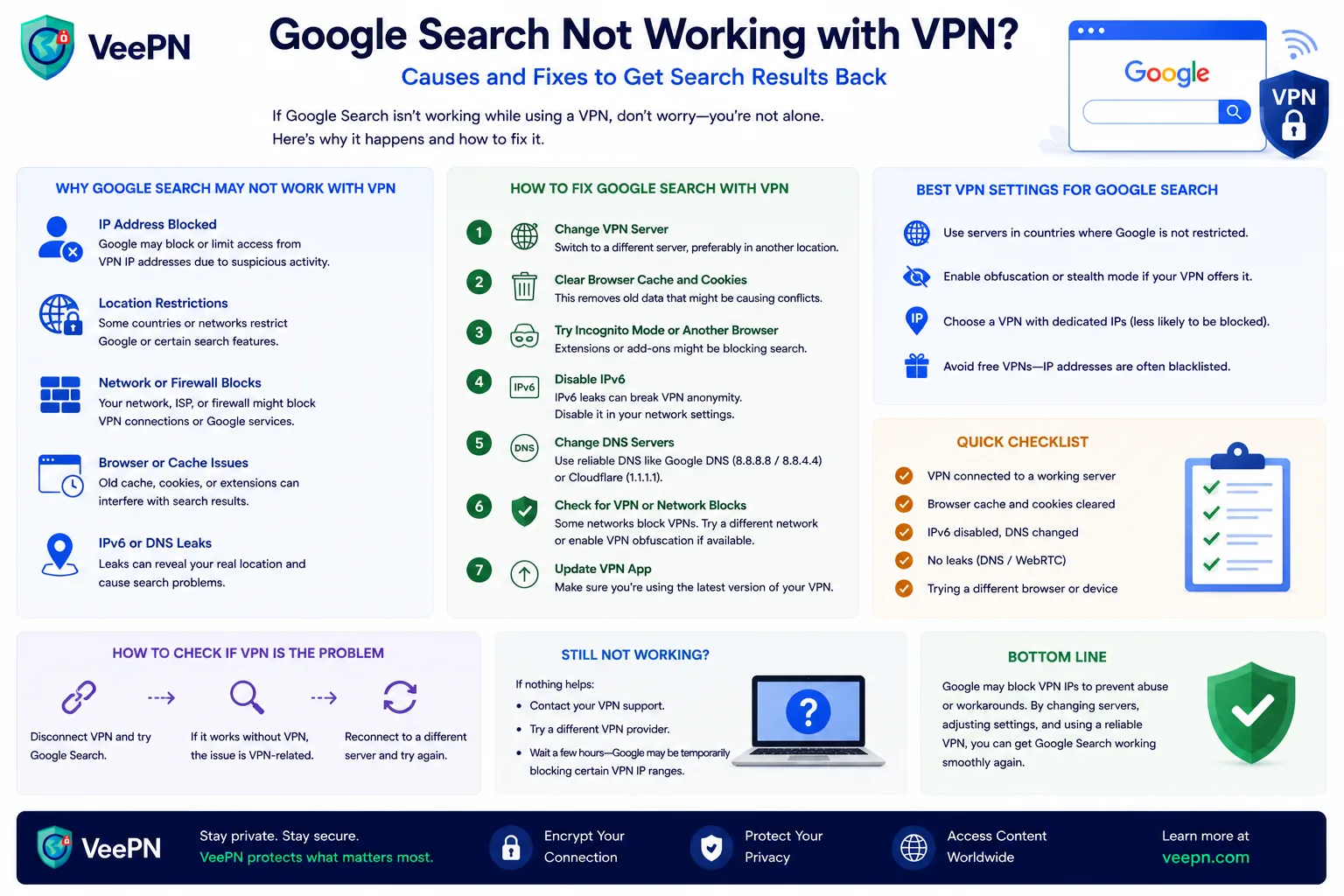
You turn on a VPN to browse normally, and suddenly Google search acts like you’re a bot. You get a captcha, results do not load, or the google search results look broken. Sometimes other websites load and everything works fine, so it feels extra confusing.
In this guide, we’ll explain the root cause in plain English and walk through practical solutions that usually fix the same issue in minutes. Near the end, we’ll also show how VeePN can help you get more consistent access without giving up privacy.
 VeePN Research Lab

 Quick Navigation
Google Search not working with VPN: why it happens
When you use a VPN, your traffic goes through a tunnel to a VPN server, so websites see the server’s IP address, not your real one. If too many VPN users share that IP, or Google sees an odd traffic pattern, its systems can treat it as risky and throw up a captcha or limit access.
It’s a classic shared-server reputation problem, not your laptop “being hacked.” Most of the time this is Google reacting to unusual traffic from an IP range, not a problem with your account.
Google has automated systems that watch for unusual traffic and behavior. A VPN can accidentally look suspicious when:
- Multiple users hit Google from the same IP at the same time.
- The IP has a history of spam, scraping, or automation.
- The request flow looks odd because of routing conflicts, flaky Wi-Fi, or dropped connections.
- Something on your device changes search behavior, such as certain extensions or aggressive ad blockers.
It’s also why one VPN app triggers more captchas than another: if a provider recycles crowded IPs or funnels many people through a few exits, Google flags that pool harder. Now let’s fix it step by step.
Check if your network or ISP causes the problem
Try another network first, like a mobile hotspot or different Wi-Fi. If the issue only persists on one network, it points to the local setup, not Google. This is common in offices, dorms, and cafés where firewalls or filtering gear interfere with DNS and HTTPS routing.
Watch for random drops
A shaky connection can make your VPN reconnect repeatedly, which changes your IP often and can look like automation. If Google sees rapid switching plus repeated queries, it may rate-limit you.
Check your device time and region
If time zone, location, and preferred region settings fight each other, Google sometimes serves odd pages or the wrong localized results. It’s not “blocked,” just messy. If your network looks normal, the next suspect is the browser itself.
Clear browser cache and cookies
A dirty cache is boring, but it causes a surprising number of “Google is broken” moments, especially with VPN routing on top.
Fix a corrupted browser cache in a clean way
- Clear the cache properly. A corrupted cache can keep loading an old redirect, a bad script, or a stale cookie that forces extra verification. Do a full clear, restart the browser, then retry Google.
- Use incognito mode as a test. It ignores most stored cookies and site data, so it’s a fast way to confirm the problem is cache-related. If Google works there, the issue is local, not your VPN.
- Don’t “half-clear.” People often delete history but keep site data. For Google problems, focus on cookies and cached files, not just visible history.
If clearing the cache didn’t help, the next suspect is what your browser does in the background.
Disable browser extensions
Some add-ons change headers, block scripts, rewrite pages, or reroute requests. With a VPN on top, that can look like automation to Google.
Audit browser extensions without nuking your whole setup
- Disable extensions one by one. Start with ad blockers, privacy script blockers, “search enhancers,” coupon tools, and anything that touches requests.
- Test a different browser. A browser with zero add-ons is the cleanest control. If Google works there, your normal browser is the culprit, not the VPN.
- Check language and region add-ons. Some force the wrong locale and confuse Google’s localization. If pages keep jumping regions while you stay in one country, disable anything that auto-translates or forces a region.
Once your browser is clean, we move to the biggest trigger of all: the IP.
Change VPN server or use a dedicated IP address
If Google thinks an IP is “busy,” it protects itself. That’s when you see repeated captchas, temporary blocks, or half-loading pages.
Switch to another VPN server
- Switch to a different server. The fastest fix. Pick another server, even another city in the same region; leaving a noisy IP often restores normal search immediately.
- Avoid “popular” locations at peak hours. Big hubs get hammered. Less crowded locations mean fewer captchas because the IP pool isn’t constantly tripping Google’s filters.
- Consider a dedicated IP if it’s constant. A dedicated IP is usually cleaner because you’re not sharing it, and it can reduce captcha loops for people who need steady logins and searching.
If swapping IPs doesn’t help, DNS is the next big lever.
When a dedicated IP helps
Shared IPs are cheaper and common, but they get flagged more often. Dedicated IPs can be calmer, though they’re not magic.
Decide if you actually need a dedicated IP
- If you search a lot for work, shared-IP friction becomes real. Captchas and “try again later” blocks cost time, especially from a crowded exit, so a dedicated IP is worth considering.
- If it only happens sometimes, stick with server switching. Most people fix it by rotating locations and avoiding congested exits.
- If you see it on one provider only, that’s a signal. Some services have more “burned” IP ranges, so Google challenges them harder.
Now let’s handle DNS, because broken DNS can look like “Google is down” when it’s really just misrouting.
Fix DNS, VPN protocol, and connection settings
When you search, your device sends DNS requests to translate domains into IPs. If DNS servers or settings are misconfigured, Google pages can load slowly, partially, or not at all.
Fix DNS the practical way
- Use the VPN’s DNS. A good VPN routes DNS lookups inside the tunnel, which reduces leaks and avoids odd ISP DNS behavior.
- Flush DNS and reconnect. If your OS holds onto a bad route, you get “it loads, then it breaks.” Flush DNS, reconnect the VPN, and retry, especially after switching servers.
- Try trusted public DNS if you must. On some networks the local DNS is slow or filtered. The key is consistency: don’t bounce between DNS providers every five minutes or you’ll keep triggering “new network” patterns.
Once DNS is stable, we finish with the settings and protocol layer that many people skip.
Change VPN protocol
If you’ve done the basics and it’s still messy, the issue may be how traffic is routed or shaped.
Small changes that can stop the loop
- Switch the VPN protocol. Some networks treat certain protocols harshly, causing timeouts and partial loads. Try a different protocol, reconnect, and test.
- Check region and language. If Google keeps serving the wrong locale, review your Google search settings, language, and preferred region. A mismatch can make results seem broken when the site is just bouncing between versions.
- Confirm your IP before and after. Compare your IP with the VPN off and on. If it doesn’t change, the VPN isn’t connected properly, or something on the network is intercepting the tunnel.
At this point most people are back to normal searching. If not, the next step is choosing a provider with a healthier IP pool and fewer overload issues.
How VeePN helps prevent Google VPN issues
No VPN can force Google to never show a captcha; Google decides that. But a reliable setup reduces how often you hit blocks and keeps your browsing safer while you troubleshoot.
- Fast server switching to escape a noisy IP. When Google starts throwing captchas, the fastest fix is a fresh exit. VeePN’s network makes it easy to move to another IP without overthinking it.
- Strong encryption. VeePN encrypts your traffic, which matters most on public networks where snoops love to watch what people search, keeping your activity harder to intercept on café Wi-Fi.
- Kill Switch. If the VPN drops mid-search, your device can fall back to your real IP without you noticing. Kill Switch blocks traffic until the tunnel is back, so you don’t bounce between identities and trigger extra “new network” challenges.
- Split tunneling. If Google is difficult on one server, split tunneling routes only certain apps through the VPN while keeping the rest normal, useful when you want control without turning protection off.
Want a cleaner, more stable option when you’re tired of fighting captchas? Try VeePN with a 30-day money-back guarantee.
FAQ
Usually Google sees shared VPN users behavior and flags the IP address for unusual traffic. That can mean captchas, blocked pages, or broken Google search results. The quickest fix is switching the VPN server and clearing browser cache. Discover more in this article.
It’s often not the VPN service itself, but the combination of a “burned” IP, strict DNS settings, or a conflicting browser extensions setup. Try incognito mode, disable add-ons (especially ad blockers), then reconnect with a different location. If the issue persists, change DNS or protocol.
Google can temporarily rate-limit or challenge requests when it detects automation-like patterns from a shared IP pool. If your VPN app keeps reconnecting due to network interruptions, it can look even stranger to the Google search engine. Switch servers, stabilize your connection, and avoid rapid repeated searches for a few minutes.
Use this quick checklist:
- Pick a less crowded server in your VPN connection list and test.
- Clear browser cache (cookies + cached files), then retry.
- Disable suspicious browser extensions and try a different browser.
- Set reliable DNS servers and avoid constant DNS switching.
- If captchas are constant, consider a dedicated IP address from a provider that offers it. Discover more in this article.


VeePN is freedom
Download VeePN Client for All Platforms
Enjoy a smooth VPN experience anywhere, anytime. No matter the device you have — phone or laptop, tablet or router — VeePN’s next-gen data protection and ultra-fast speeds will cover all of them.
Download for PC Download for Mac IOS and Android App
Want secure browsing while reading this?
See the difference for yourself - Try VeePN PRO for 3-days for $1, no risk, no pressure.
Start My $1 TrialThen VeePN PRO 1-year plan