Deutsch
  Español
  Français
  العربية
  Indonesia
  Italiano
  한국어
한국어  Nederlands
  Polski
  Português
  Türkçe
  简体中文
简体中文  ไทย
ไทย  Tiếng Việt
  Čeština
  فارسی
فارسی  Română
  Filipino
  日本語
日本語 


Are VPNs Legal in the US? What You Should Know Before You Use One
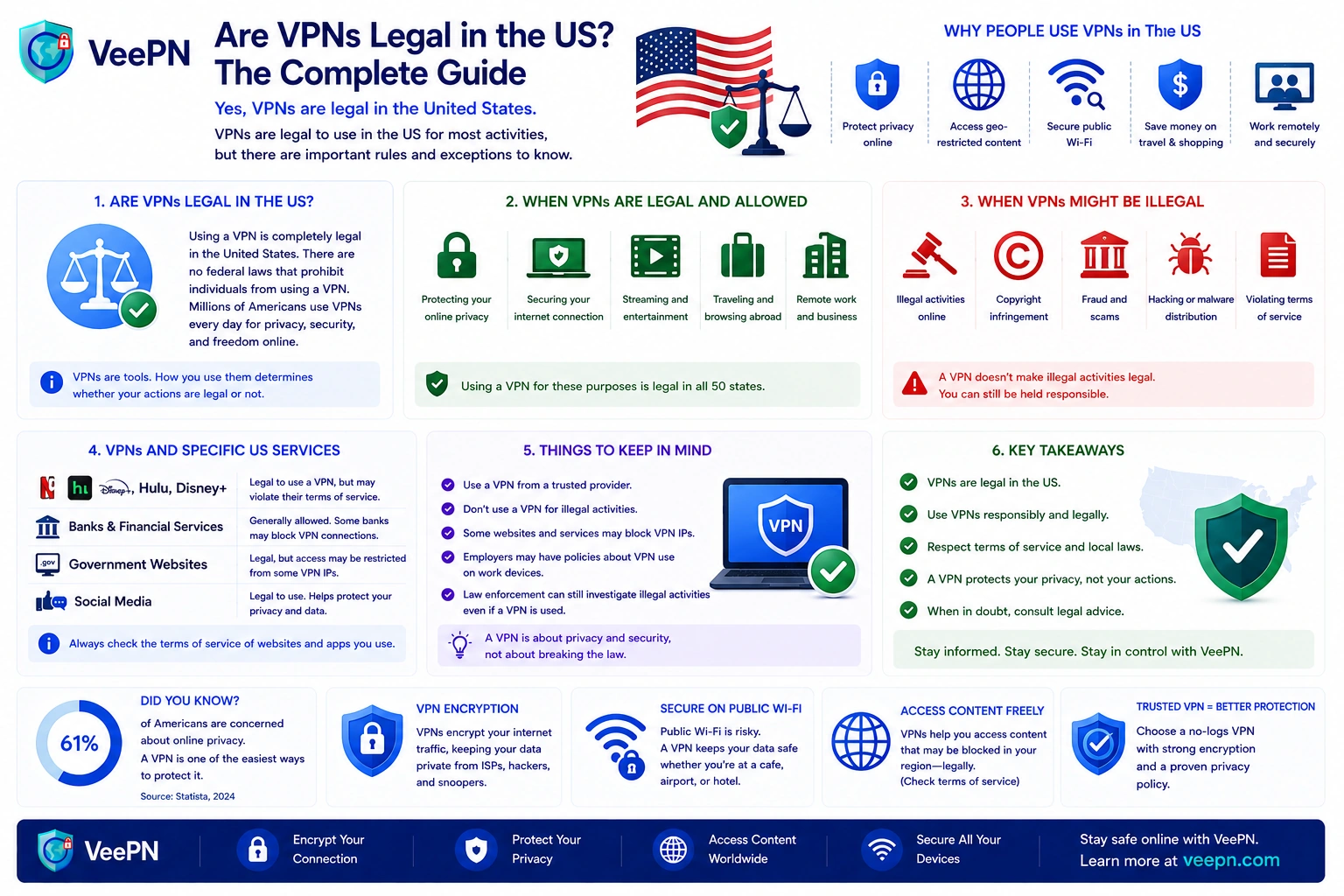
VPNs are legal in the United States. VPN is just a common tool that people use to work, travel, browse the web safely and enjoy a little more privacy on the Internet.
Using a VPN is legal. But it is also very important what you do with it. A VPN can protect your Internet traffic, but it doesn’t reduce your responsibility for your activities. If someone uses a VPN for fraud, hacking, or other illegal activities, they can still be investigated and charged. The DOJ has gone after criminal operations that used VPN services as part of their activity.
So if your main question is Are VPNs Legal in the US, the plain answer is yes. The smarter question is where people get confused, and where the real risk starts.
 VeePN Research Lab


 Quick Navigation
2. Why this topic feels more confusing than it should
3. Why people in the US use a VPN in the first place
4. Can websites detect VPN usage and block it?
5. When using a VPN can actually become a problem
6. What to look for in VPN providers
7. Why VeePN makes sense for legal, everyday VPN use
FAQ
Are VPNs banned in the US?
No. There’s no broad US ban on virtual private networks. People use VPN services every day for remote work, safer internet access, and protecting logins on public Wi-Fi, and you don’t look suspicious just for turning one on.
What does happen is far less dramatic. A company may block VPN apps on its internal network. A school may not want students routing traffic outside its filters. A streaming service may refuse playback if it thinks you’re masking your location. Those are private rules and platform limits, not proof that VPNs are illegal; Netflix says as much openly in its help pages.
That’s why so many articles on this topic feel messy: they take VPN bans, VPN blocks, account restrictions, and actual law, then throw them all into one pile.
Why this topic feels more confusing than it should
A lot of readers aren’t really asking about the law. They’re asking about consequences.
If Netflix notices a VPN, it may not show the full regional library, or it may ask you to switch the VPN off. That’s annoying, but it isn’t breaking US law; it’s just a service deciding how to handle location-based access.
The same goes for work and school networks. A private network can block VPN traffic or limit access if that’s part of its security policy. So yes, something can be blocked without being illegal, and that’s the piece many people miss.
There’s also the global angle. People read about stricter VPN laws abroad, or countries where VPN use is tightly controlled, and assume the same must be true in the US. It usually isn’t.
Why people in the US use a VPN in the first place
Most VPN users don’t have anything shady in mind. They just want a bit more control over their connection.
Better protection on public Wi-Fi
Don’t fully trust the public Wi-Fi at an airport, hotel, or café. A VPN gives you an encrypted connection, so someone nearby is far less likely to snoop on your traffic. That matters when you’re checking email, a banking app, or anything personal.
More privacy in everyday browsing
A VPN wraps your traffic in an encrypted tunnel through a VPN server, which makes it harder for an outsider to intercept on the way. It won’t make you invisible, but it does add distance between your activity and the people trying to profile it. For many users, that’s the whole point.
A little less visibility for your ISP
Some people also use a VPN to reduce how much their internet provider can see about the traffic they’re handling. Because it’s encrypted, it’s harder to inspect in detail, which is why VPNs come up when people want to avoid ISP throttling, though a VPN isn’t a magic fix for every slow connection. In short, most people aren’t using a VPN to vanish; they’re protecting passwords, hiding their visible IP, and making the connection feel a bit safer.
Can websites detect VPN usage and block it?
Yes, sometimes. Some sites and apps try to detect VPN usage by checking known data-center IP ranges, shared addresses, or unusual location changes, which is why you’ll occasionally see a message saying a service thinks you’re behind a VPN or proxy. Netflix has entire help pages built around exactly this.
That doesn’t mean every VPN gets caught every time. It just means some platforms actively try to block VPN users or stop people getting around location rules. In most cases the result isn’t legal trouble; it’s a playback error, a missing catalog, or a request to turn the VPN off. So can a site block a VPN? Yes. Does that make VPNs illegal? Still no.
When using a VPN can actually become a problem
Usually the VPN itself isn’t the issue. Behavior is.
If someone uses a VPN while committing fraud, piracy, or hacking, it offers no protection from the law. That’s worth saying plainly, because people still treat VPNs like a legal shield. They aren’t. The DOJ has repeatedly shown that law enforcement can pursue cybercrime even when VPN infrastructure or masked network activity is involved.
There’s also the smaller, more ordinary kind of trouble. Your employer may not allow personal VPN apps on company devices. A school network may block them. A streaming platform may stop showing content when it notices location masking. None of that is criminal liability, but it can still create consequences. And if you travel, local laws matter: a VPN that’s completely routine in the US may be treated very differently elsewhere. So the safest answer on VPN legality is always tied to country, context, and what you’re doing online.
What to look for in VPN providers
Once you know VPNs are legal in the US, the next question is which providers are worth trusting.
A good provider should be clear about privacy. If a company is vague about logging or seems too keen to collect user data, that’s a red flag; the whole point of a VPN is to reduce exposure, not quietly create a new record of your activity.
It should also have the security basics in place. Strong encryption, leak protection, and a stable server network matter more than flashy marketing. A VPN that’s slow, unreliable, or prone to leaks stops being useful fast.
That’s also why free tools can be a gamble. Some are fine for light use; others are slow, crowded, or loose with privacy. For daily use, trust matters more than a “free” label.
Why VeePN makes sense for legal, everyday VPN use
If your goal is simple, meaning safer browsing, better privacy, and fewer surprises, VeePN fits that use case well.
- AES-256 encryption. The core layer that protects your traffic on public Wi-Fi and other networks you don’t fully trust, turning ordinary browsing into a safer, encrypted connection.
- IP masking. Changes your visible IP for a useful layer of privacy. It won’t make you invisible, but it makes casual tracking and easy profiling harder.
- No Logs. VeePN says it keeps zero browsing, DNS, or search logs. If privacy is the whole reason you wanted a VPN, this is one of the biggest boxes to tick.
- Kill Switch. If the VPN drops for a moment, it stops traffic leaking onto your regular connection, because privacy failures often happen in those brief gaps you don’t notice.
Want a VPN that stays straightforward in daily life? Try VeePN with a 30-day money-back guarantee.
FAQ
Yes. In the US, VPNs are legitimate and many people use them in the workplace, privacy and secure browsing. It is so basic: use it in good ways and respect the guidelines of the network or service in which you are. Find out more in this article.
No, in most situations, troubles start when a person is committing an illegal act by using a VPN. They break school or work rules, or they are exposed to a platform where they cannot hide their location.
A VPN can improve privacy, but it is not a magic cloak. In serious cases, investigators may still rely on device evidence, account data, seized infrastructure, or other digital trails.
In more cases, Netflix restricts or requests you to disable the VPN. Its help pages state that the use of VPN might interfere with what titles you see and some plans simply cannot be used with VPN. Find out more in this article.


VeePN is freedom
Download VeePN Client for All Platforms
Enjoy a smooth VPN experience anywhere, anytime. No matter the device you have — phone or laptop, tablet or router — VeePN’s next-gen data protection and ultra-fast speeds will cover all of them.
Download for PC Download for Mac IOS and Android App
Want secure browsing while reading this?
See the difference for yourself - Try VeePN PRO for 3-days for $1, no risk, no pressure.
Start My $1 TrialThen VeePN PRO 1-year plan