Deutsch
  Español
  Français
  العربية
  Indonesia
  Italiano
  한국어
한국어  Nederlands
  Polski
  Português
  Türkçe
  简体中文
简体中文  ไทย
ไทย  Tiếng Việt
  Čeština
  فارسی
فارسی  Română
  Filipino
  日本語
日本語 


SIM Swap Attack: How Scammers Steal Your Number and Your Accounts
A SIM swap attack is one of those scams that sounds technical, but the damage is painfully simple. A criminal hacks into your phone number and starts to receive your text messages and phone calls. Then, they use the access you have to hack into your financial accounts, email, and social media accounts.
The frightening fact is that the attacker does not usually require your phone at all! They simply need a sufficient amount of personal information, a plausible story, and a weakness at your carrier in most situations.
We’ll walk through how it works, what signs to watch for, and how a VPN like VeePN can help reduce the fallout.
 VeePN Research Lab

 Quick Navigation
2. How SIM swap fraud occurs through a SIM card change
3. Why SIM swapping breaks multi-factor authentication
4. What to do the moment SIM swap fraud occurs
5. How to prevent SIM swapping with carrier locks and security questions
6. Why VeePN helps reduce the fallout of a SIM swap attack
FAQ
What a SIM swap attack really does to your phone number
The target of this scam is your mobile account, not your handset. In a SIM swap, a criminal convinces your carrier to move your number to a new SIM, an eSIM, or a device they control, which is why it’s also called SIM hijacking or SIM jacking. Once the transfer goes through, your real phone loses service and the attacker starts receiving your calls and texts.
This isn’t just theory:
- In January 2024, the SEC said the hack of its @SECGov X account happened through SIM swapping.
- Back in August 2019, The Guardian reported that Jack Dorsey’s X account was compromised after the number tied to it was taken over at the carrier.
How SIM swap fraud occurs through a SIM card change
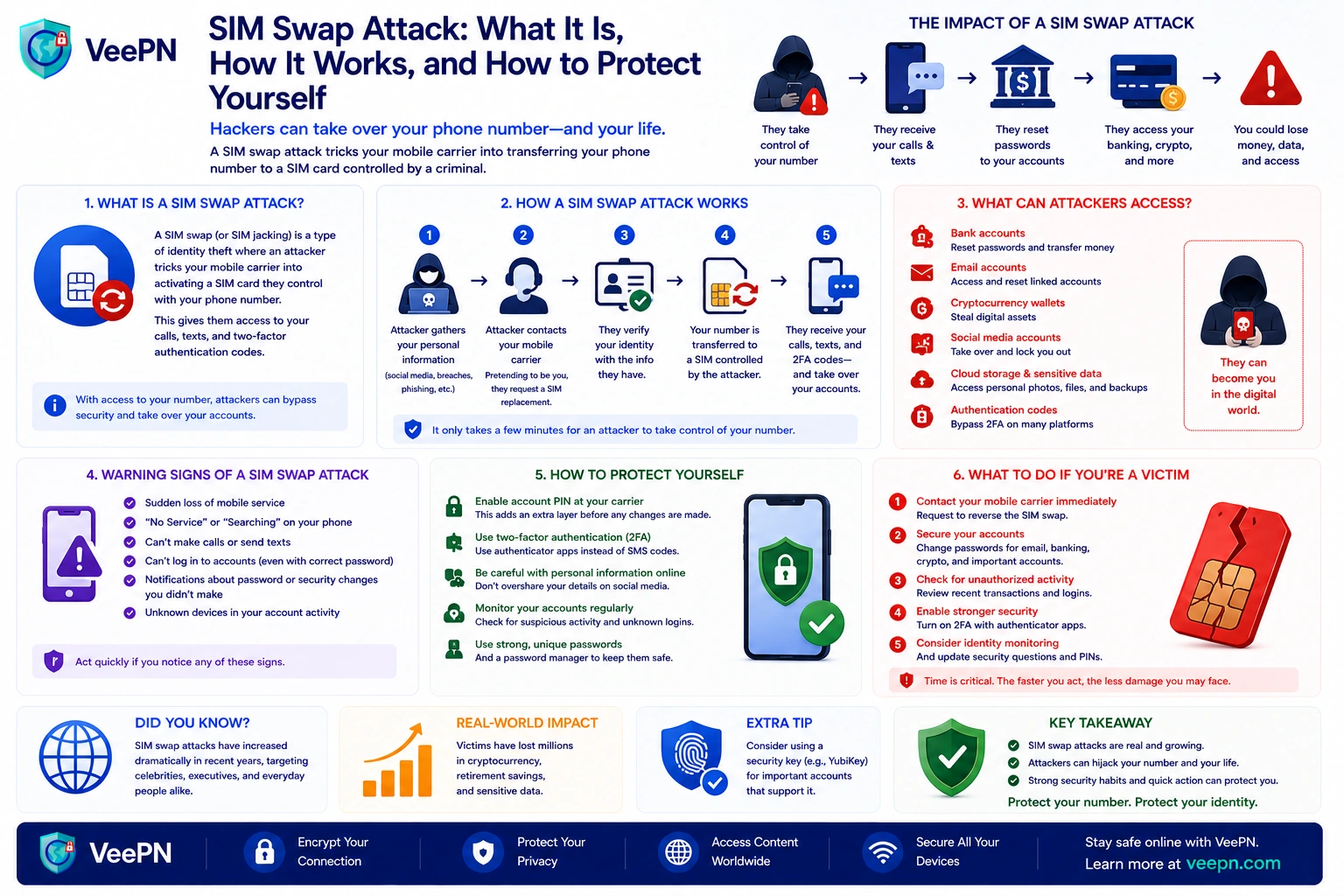
Most SIM swap fraud isn’t advanced hacking. It’s social engineering. Fraudsters gather personal details (name, date of birth, address, sometimes a Social Security number) from phishing, old breaches, social media, or the dark web, then use them to pass the carrier’s identity checks.
A typical run looks like this:
- Collect data tied to your identity, from leaks, fake support messages, or public social profiles.
- Contact the carrier and request a SIM change, claiming the SIM was lost, the phone was damaged, or a new device needs activating.
- The carrier moves the number to the fraudster’s SIM, and authentication codes, one-time passcodes, and account alerts start flowing to them.
- Take over the accounts, trigger password resets and walk into the email, banking, and crypto apps tied to that number.
That’s why a single successful swap snowballs so fast: a stolen number becomes a shortcut to your most sensitive accounts and, often, full identity theft. The FBI has warned that these scams are commonly used to bypass security on financial and online accounts.
Why SIM swapping breaks multi-factor authentication
Many people assume two-factor authentication makes an account safe. It helps, but SMS codes have a weak spot: if your number is hijacked, the attacker receives the very second factor meant to stop them, turning your extra login step into a liability.
That’s why the method matters:
- The FTC says authenticator apps are safer than texted codes, because the passcode can’t be moved with your SIM.
- For higher-risk people and high-value logins, the FTC points to hardware security keys as the strongest option.
- Google similarly promotes passkeys and security keys as stronger protection against phishing.
So if your email, crypto wallet, work account, or bank app supports an authenticator app, passkeys, or a hardware key, that beats relying on SMS alone.
What to do the moment SIM swap fraud occurs
The first clue is often sudden silence, your phone loses bars where it normally works. Once you reconnect, you may see alerts about a SIM change, failed logins, or strange account notices.
Watch for these red flags:
- Your phone loses service for no clear reason. If you’re in a normal coverage area and still can’t call or text, act immediately.
- Unexpected notices about a new SIM, a password change, or account access you didn’t request.
- Your email, bank, or social apps reject your password, often a sign the attacker has already started resets.
- Strange call-backs or alerts from financial institutions, which can mean they’re already reaching for your money.
If it happens, call your carrier from another line right away, then lock your email first, followed by your bank and other sensitive accounts. Your email is usually the master key, secure that, and the rest gets much easier.
How to prevent SIM swapping with carrier locks and security questions
The good news: this scam is very preventable with a few habits. In November 2023 the FCC adopted rules requiring stronger carrier authentication and immediate notice of SIM-change or port-out requests, effective July 8, 2024. Major carriers now also offer extra protections like Verizon Number Lock and SIM Protection, T-Mobile SIM Protection, and AT&T Wireless Account Lock.
A short checklist that actually helps:
- Set a strong carrier PIN. Not a birthday or anything tied to your personal details, many swaps still succeed on weak security questions.
- Move important logins off SMS. Put email, banking, crypto, and work tools on an authenticator app or hardware key.
- Use unique passwords everywhere. Reused passwords make a swap far worse, since one stolen email opens many accounts.
- Reduce what’s tied to your number. The fewer services using SMS recovery, the less an attacker can do.
- Share less online. Public birthdays, old addresses, pet names, and school info all feed social-engineering, especially on public profiles.
It also helps to know how phishing sites trick people and what to do if you click a phishing link. And while an eSIM can’t simply be pulled from a stolen device, carrier-level fraud can still happen, so it’s not a magic fix on its own.
Why VeePN helps reduce the fallout of a SIM swap attack
A VPN can’t stop a carrier from making a bad account change. But a SIM swap rarely begins and ends at the carrier. It overlaps with phishing, bad links, exposed Wi-Fi, and leaked credentials, which is where VeePN earns its place.
- NetGuard. Blocks malicious sites, trackers, and shady redirects, useful because many swaps begin with fake carrier messages or phishing pages.
- Breach Alert. The personal data that fuels a swap usually comes from old leaks; Breach Alert warns you when your credentials surface where they shouldn’t.
- AES-256 encryption. Protects logins and financial activity on café, hotel, and airport Wi-Fi, exactly when scammers try to grab more data before or after a swap.
- Kill Switch. If the connection drops, it stops traffic from leaking onto the open network while you’re locking down email and banking.
Use VeePN for protection against the phishing, unsafe Wi-Fi, and leaked credentials that surround these attacks. 30-day money-back guarantee.
FAQ
Yes. A SIM swap attack usually targets your phone number and mobile account, not the handset in your pocket. The criminal convinces the carrier to move your number to another SIM card and then uses that for account access. Discover more in this article.
Start fast. Act immediately and do these steps:
- Call your carrier from another line and report suspected SIM swap fraud.
- Lock email, banking, and other financial accounts.
- Switch critical logins to Google Authenticator or another app-based method.
Change reused passwords on your most important accounts
Discover more in this article.


VeePN is freedom
Download VeePN Client for All Platforms
Enjoy a smooth VPN experience anywhere, anytime. No matter the device you have — phone or laptop, tablet or router — VeePN’s next-gen data protection and ultra-fast speeds will cover all of them.
Download for PC Download for Mac IOS and Android App
Want secure browsing while reading this?
See the difference for yourself - Try VeePN PRO for 3-days for $1, no risk, no pressure.
Start My $1 TrialThen VeePN PRO 1-year plan