Deutsch
  Español
  Français
  العربية
  Indonesia
  Italiano
  한국어
한국어  Nederlands
  Polski
  Português
  Türkçe
  简体中文
简体中文  ไทย
ไทย  Tiếng Việt
  Čeština
  فارسی
فارسی  Română
  Filipino
  日本語
日本語 


Employment Identity Theft: Warning Signs, Risks, and How to Respond
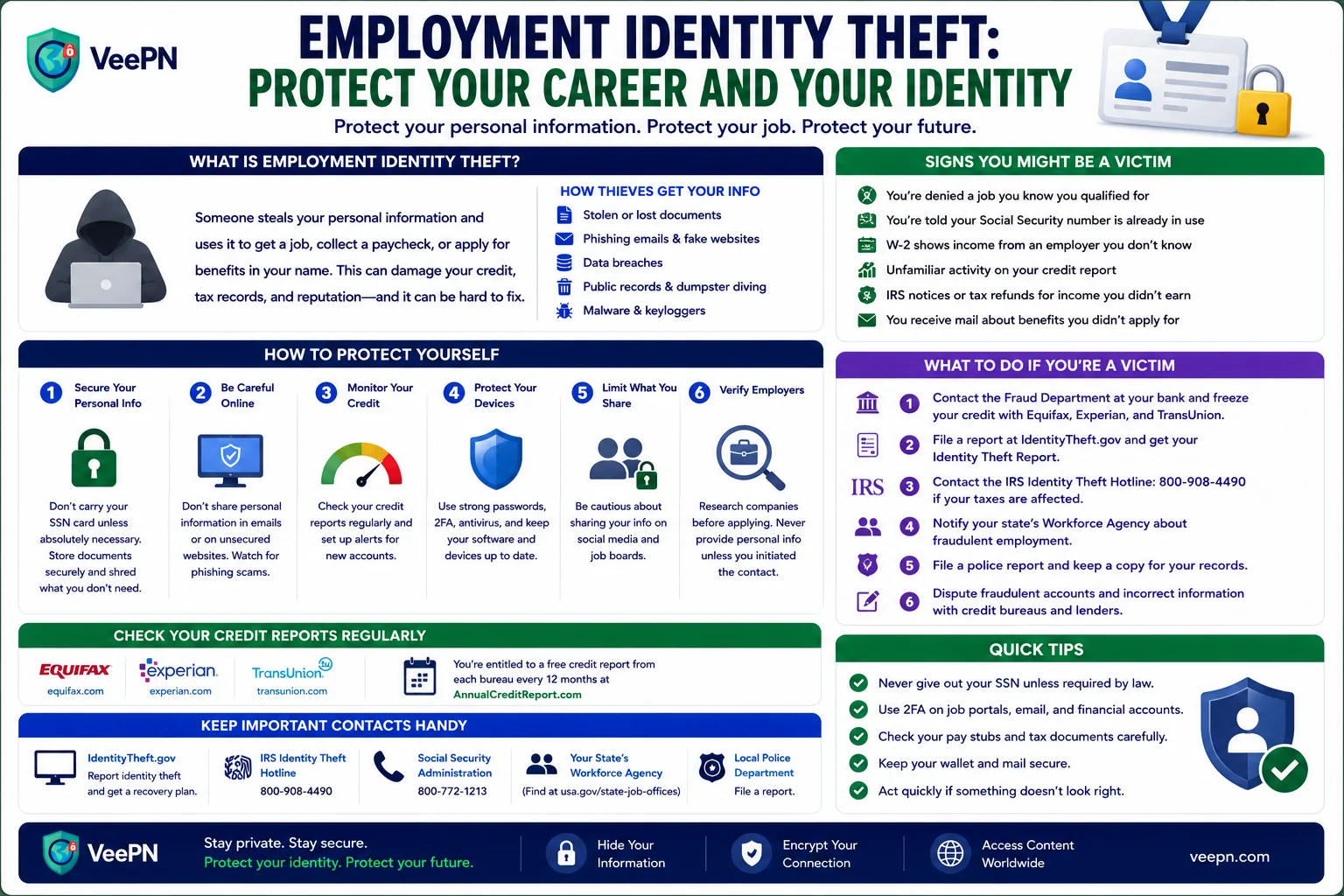
Employment identity theft occurs when someone uses another person’s personal information—often a Social Security number (SSN)—to obtain a job, pass employment verification checks, or report earnings under a false identity.
Unlike credit card fraud, employment identity theft can remain unnoticed for months or even years. Victims often discover it only after receiving unexpected tax notices, finding unfamiliar income on government records, or encountering problems during background checks.
Understanding how this type of fraud works can help you recognize the warning signs early and reduce the risk of long-term financial and administrative problems.
 VeePN Research Lab


 Quick Navigation
What Is Employment Identity Theft?
Employment identity theft is a form of identity fraud in which a criminal uses someone else’s identifying information to gain employment or work authorization.
The stolen information may include:
- Social Security numbers
- Full names
- Dates of birth
- Driver’s license information
- Home addresses
When wages are reported under the victim’s identity, government records can become inaccurate. This may lead to tax complications, incorrect earnings histories, or difficulties when applying for loans, benefits, or future employment.
How Employment Identity Theft Happens
Most cases begin with stolen personal information. Criminals may obtain that information through:
- Data breaches
- Phishing emails and fake job offers
- Compromised online accounts
- Stolen mail or documents
- Social engineering scams
- Poorly secured databases
Once they have enough information, they may use it to complete hiring paperwork or employment verification forms.
In many cases, the victim remains unaware until a government agency, employer, or tax authority identifies a discrepancy.
Common Warning Signs
Employment identity theft often reveals itself through unexpected notices or inconsistencies in official records.
Watch for:
- IRS notices about income you did not earn
- A Social Security earnings record showing unfamiliar employers
- Tax forms from companies you never worked for
- Problems during employment background checks
- Collection notices related to wages or benefits you never received
- Unexpected reductions or discrepancies in government benefit records
If any of these situations occur, investigate promptly rather than assuming they are administrative errors.
Why Employment Identity Theft Can Be Difficult to Detect
Unlike traditional financial fraud, employment identity theft may not immediately affect your bank account or credit score.
Instead, the damage often appears in government records and employment histories. As a result, victims may continue filing taxes normally for years before discovering that someone else has been working under their identity.
This delayed discovery can make correction more complicated because multiple agencies may need to update their records.
Check Your Records Regularly
Routine monitoring can help identify problems earlier.
Consider reviewing:
- Your Social Security earnings history
- Annual tax records
- Credit reports from the major credit bureaus
- Employment-related correspondence from government agencies
While employment identity theft does not always appear on a credit report, reviewing your credit files can still help detect broader identity theft activity.
Employment Identity Theft Warning Signs
| Warning Sign | What It May Indicate | Recommended Action |
|---|---|---|
| IRS notice about unreported income | Someone may be working under your SSN | Contact the IRS and review wage records |
| Unknown employer on Social Security earnings record | Fraudulent employment activity | Report the discrepancy to the Social Security Administration |
| Tax forms from an unfamiliar company | Wages reported under your identity | Contact the employer and relevant agencies |
| Failed background check due to incorrect employment history | Fraudulent records attached to your identity | Request copies of reports and dispute inaccuracies |
| Unexpected collection notices | Benefits or wages linked to fraudulent activity | Investigate immediately and document communications |
What to Do If You Become a Victim
If you suspect employment identity theft:
- Review your Social Security earnings record for inaccuracies.
- Contact the Internal Revenue Service (IRS) if tax records appear incorrect.
- Visit the Federal Trade Commission’s identity theft recovery resources and create a recovery plan.
- Consider placing a fraud alert or credit freeze with the major credit bureaus.
- Keep copies of all correspondence and documentation.
- Notify affected employers or agencies when appropriate.
The recovery process may take time, but early reporting can help limit additional complications.
Protecting Your Personal Information
No single tool can prevent identity theft, but a combination of good security practices can reduce risk.
Some practical steps include:
- Avoid sharing your Social Security number unless necessary.
- Verify the legitimacy of employers before submitting sensitive information.
- Use strong, unique passwords for employment and financial accounts.
- Enable multi-factor authentication whenever available.
- Shred documents containing sensitive personal information before disposal.
- Be cautious when using public Wi-Fi for job applications or financial activities.
Where a VPN Fits Into the Picture
A VPN is not a solution for identity theft, and it cannot stop fraud if your information has already been exposed in a breach.
However, a VPN can help protect data while it is being transmitted over the internet, particularly when using public Wi-Fi networks. This can reduce the risk of interception on unsecured connections when accessing employment portals, email accounts, or other sensitive services.
VPNs should be viewed as one layer of a broader security strategy that also includes strong passwords, multi-factor authentication, device security, and awareness of phishing scams.
If you are affected, the FTC’s IdentityTheft.gov walks you through an official recovery plan, and the IRS identity-theft resources cover tax-related employment fraud. To limit exposure beforehand, VeePN’s Data Breach Alert flags leaked personal data, Alternative ID keeps your real details off low-trust forms, and Anonymous Email reduces how often your main address is exposed.
Final Thoughts
Employment identity theft can create problems that extend far beyond a single fraudulent transaction. Incorrect tax records, unfamiliar employers on your earnings history, and administrative complications can take significant time to resolve.
The best defense is early detection. Regularly reviewing your records, protecting sensitive information, and responding quickly to suspicious activity can help minimize the impact if your identity is misused.


VeePN is freedom
Download VeePN Client for All Platforms
Enjoy a smooth VPN experience anywhere, anytime. No matter the device you have — phone or laptop, tablet or router — VeePN’s next-gen data protection and ultra-fast speeds will cover all of them.
Download for PC Download for Mac IOS and Android App
Want secure browsing while reading this?
See the difference for yourself - Try VeePN PRO for 3-days for $1, no risk, no pressure.
Start My $1 TrialThen VeePN PRO 1-year plan