Deutsch
  Español
  Français
  العربية
  Indonesia
  Italiano
  한국어
한국어  Nederlands
  Polski
  Português
  Türkçe
  简体中文
简体中文  ไทย
ไทย  Tiếng Việt
  Čeština
  فارسی
فارسی  Română
  Filipino
  日本語
日本語 


Are VPNs Legal in the UK?
Yes. You can go on using this privacy tool. VPNs are legal in the UK. IF you are just a common user, you are still able to use virtual private networks for privacy, safer browsing, work, and everyday security.
The recent fuss around it came out from the Online Safety Act, strong age verification rules, and also public debate. The latter was around children using VPNs to get around those checks. But that is not the same thing as a full ban you could think of.
So far, using a VPN is legal. What matters more in this connection is what you do while being connected. A VPN protects all your web traffic, but it definitely does not turn any illegal activity into something lawful. IN this article, we’ll walk through what changed, why many people got confused, and how to use a VPN in a sensible and legal way in the UK.
 VeePN Research Lab


 Quick Navigation
2. UK Privacy Context
3. What a VPN Does Not Protect
4. How To Use a VPN Safely in the UK
5. Where VeePN Fits
6. Law, Terms of Service, and Workplace Rules Are Different
7. What UK Law Actually Changes for Privacy
8. Public Wi-Fi Is the Clearest Everyday Use Case
9. Streaming and Location: Be Precise
10. What a VPN Does Not Hide
11. Choosing a VPN for UK Use
12. A Note for Travelers
13. Common UK Examples
14. Accuracy Notes Worth Knowing
15. Reader Mistakes Worth Preventing
16. Practical bottom line for UK readers
17. Short examples that clear up confusion
18. Extra Clarity on “Legal but Blocked”
19. The short answer
FAQ
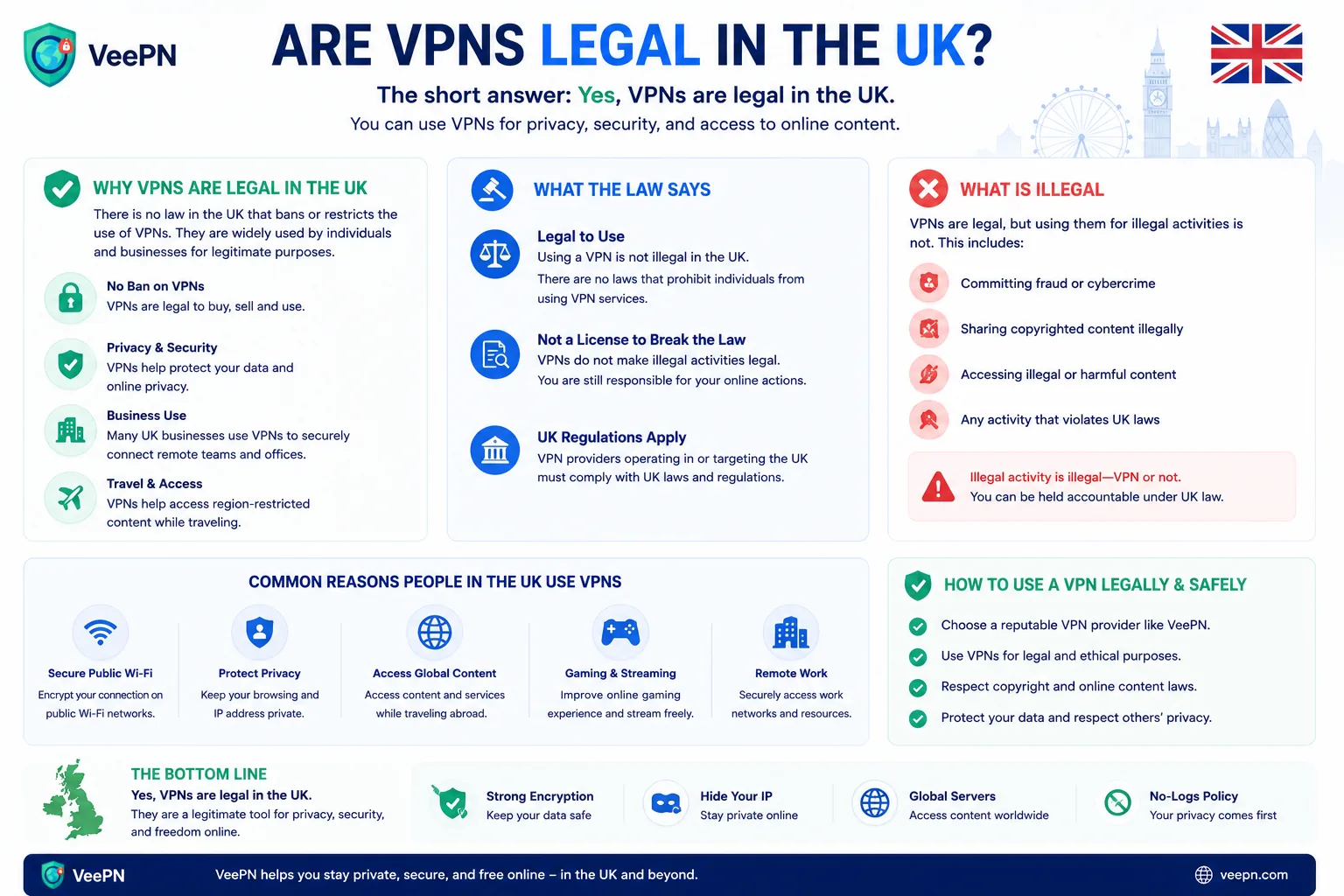
Yes, VPNs are legal in the UK. You can use a VPN for privacy, safer public Wi-Fi, remote work, travel, and protecting your connection. The important limit is simple: a VPN does not make illegal activity legal.
This article is for UK users who want a clear answer without scare tactics.
What Is Legal
| Use case | Generally legal? | Notes |
|---|---|---|
| Protecting traffic on public Wi-Fi | Yes | Common privacy use |
| Remote work access | Yes | Many companies require VPNs |
| Reducing IP-based tracking | Yes | Does not make you anonymous everywhere |
| Accessing your accounts while traveling | Yes | Services may still flag unusual logins |
| Copyright infringement | No | VPN use does not change copyright law |
| Harassment, fraud, hacking | No | Still criminal activity |
VPN legality and platform terms are different questions. A streaming service may restrict VPN use in its terms even if VPNs are legal under UK law.
UK Privacy Context
The UK has surveillance and data-retention laws that shape how communications providers and public authorities may handle data. A VPN can reduce what your local network or internet provider sees about your browsing destinations, but it does not remove all records everywhere.
Your VPN provider can still see connection metadata depending on its systems and policies. Websites can still identify you through accounts, cookies, device fingerprints, and payment details.
What a VPN Does Not Protect
A VPN does not stop phishing. It does not make malware safe. It does not erase your activity inside logged-in accounts. It does not guarantee access to every streaming library. It does not protect you if you voluntarily share personal information on a website.
How To Use a VPN Safely in the UK
Choose a provider with clear privacy policies. Keep the app updated. Turn on Kill Switch if you need leak protection. Use MFA on important accounts. Avoid free VPNs that make unclear data-use claims. Do not rely on a VPN as your only security tool.
If privacy is the goal, combine the VPN with browser privacy settings, tracker blocking, strong passwords, and careful account hygiene.
Where VeePN Fits
VeePN can be used legally in the UK for privacy, public Wi-Fi protection, travel, and everyday browsing. Its value is network privacy: encrypting traffic between your device and the VPN server and masking your visible IP address from sites you visit.
It should be used responsibly and in line with applicable laws and service terms.
Law, Terms of Service, and Workplace Rules Are Different
A lot of confusion comes from mixing three separate questions.
First: is VPN use legal under UK law? For ordinary privacy and security use, yes.
Second: does a platform allow VPN use under its terms? That depends on the platform. Streaming, gaming, banking, ticketing, and shopping sites may apply their own rules or risk checks.
Third: does your employer, school, or network owner allow it? A workplace can require its own VPN and block personal VPNs on managed devices. A school network can restrict VPN traffic under acceptable-use rules.
| Situation | Legal issue? | Practical issue? |
|---|---|---|
| Using a VPN at a cafe | Usually no | Choose a trusted provider |
| Using a work VPN for remote access | Usually no | Follow employer policy |
| Using a VPN for fraud or hacking | Yes | VPN does not legalize crime |
| Using a VPN with streaming apps | Usually no | May violate platform terms |
| Using personal VPN on work laptop | Usually no | May violate IT policy |
| Using a VPN in a country with restrictions while traveling | Depends | Check local law before travel |
This is the answer most people are looking for: VPN legality is one thing, while platform rules and workplace policies are separate issues.
What UK Law Actually Changes for Privacy
The UK has a legal framework for surveillance, communications data, and investigatory powers. The Investigatory Powers Act 2016 is part of that context. A consumer VPN does not erase the existence of legal powers, provider records, account logs, payment data, or device evidence.
What it can do is reduce visibility for local networks and internet providers. Without a VPN, the network operator can often see the domains or services you connect to, even when HTTPS protects page contents. With a VPN, the operator sees an encrypted connection to the VPN server instead.
That is a privacy improvement, not a legal invisibility cloak.
Public Wi-Fi Is the Clearest Everyday Use Case
The most straightforward UK use case is public Wi-Fi. Hotels, airports, trains, cafes, coworking spaces, and rented accommodation can put users on networks they do not control. A VPN helps protect traffic between the device and VPN server, which is especially useful when signing into email, banking, work tools, or shopping accounts.
The UK’s National Cyber Security Centre publishes general advice on staying secure online, including the importance of updates, strong passwords, and account protection. A VPN fits into that broader hygiene. It is not a substitute for MFA or safe passwords.
Streaming and Location: Be Precise
It is legal to have a VPN app installed in the UK. It is also common for streaming platforms to license content by region and enforce their terms. Those are separate facts.
A VPN can change the IP address websites see, but streaming services may detect VPN traffic, apply account-region rules, or restrict access based on their terms. Do not assume a VPN will access every library or bypass every restriction.
VeePN’s UK VPN page is relevant for users who want a UK server. VPN for streaming is relevant when the goal is privacy and access within legal and service-term limits.
What a VPN Does Not Hide
A VPN does not hide activity from a website you log into. If you sign into your Google, bank, Klarna, Netflix, or employer account, that service can still identify your account. A VPN does not remove cookies, browser fingerprints, device IDs, payment records, shipping addresses, or voluntary form submissions.
It also does not protect against phishing. A fake login page can steal a password over an encrypted VPN connection just as easily as over a normal connection. That is why phishing-site awareness and Link Checker fit naturally as internal resources.
Choosing a VPN for UK Use
For UK readers, the useful checklist is practical:
- Clear privacy policy.
- Apps for the devices you actually use.
- Kill Switch for connection drops.
- UK and nearby European servers for speed.
- Support for phones, laptops, and routers if needed.
- No exaggerated anonymity promises.
VeePN’s Kill Switch and No Logs VPN are relevant here: Kill Switch helps prevent traffic from continuing outside the tunnel if the VPN drops, and no-logs protection depends on the provider’s published policy.
A Note for Travelers
This guide is UK-focused, but readers travel. VPN legality varies by country. Some countries restrict VPN use, require approved providers, or block VPN traffic. Before traveling, check local rules rather than assuming UK norms apply everywhere.
That caveat matters because a UK-focused legal answer should not be read as global advice.
Common UK Examples
A student using a VPN on home broadband to keep browsing private is not doing anything illegal by using the VPN. A contractor connecting to a company VPN to access internal tools is using the technology exactly as intended. A traveler using a UK server to check a bank account may still face extra verification, but the VPN itself is not the legal problem.
Different example: someone uses a VPN to harass another person, run fraud, hack accounts, or distribute stolen material. The VPN does not change the underlying conduct. Investigators can use account records, device evidence, payment trails, platform logs, and other sources.
Examples move the topic away from abstract legality and into everyday decisions.
Accuracy Notes Worth Knowing
Keep the headline answer direct. “Yes, VPNs are legal in the UK” should appear early, because readers are often looking for reassurance before detail.
Avoid saying “VPNs are completely anonymous” or “VPNs protect you from tracking.” The better phrasing is narrower: a VPN masks your IP address from websites you visit and encrypts traffic between your device and the VPN server. Websites can still track logged-in accounts, cookies, device fingerprints, and behavior.
UK law does not require ordinary consumers to use or avoid VPNs. It is more accurate to separate lawful use, illegal conduct, service terms, and practical privacy limits.
UK VPN fits readers who need a UK server, Kill Switch fits leak protection, No Logs VPN fits provider trust, and VPN encryption fits the tunnel explanation. Not every VPN feature needs to be mentioned.
Reader Mistakes Worth Preventing
Some readers assume that if VPNs are legal, every VPN use is allowed everywhere. Others assume that if a streaming service blocks VPNs, VPNs must be illegal. Both assumptions are wrong.
A VPN can be legal while a platform still blocks it. A platform rule can be real without being a criminal law. A work policy can forbid personal VPN apps on managed laptops even though the same app is legal on a personal phone.
Practical bottom line for UK readers
Use a VPN for privacy, security on public Wi-Fi, travel, and remote work. Do not use it as cover for activity that would be illegal without a VPN. Read platform terms if streaming, gaming, banking, or ticketing access matters. Follow employer rules on managed devices.
Concise takeaway: VPNs are legal in the UK, but they are not a permission slip. They protect the connection; they do not legalize the action.
Short examples that clear up confusion
If someone asks whether they can get fined just for installing a VPN app in the UK, the answer is no for ordinary consumer use. If someone asks whether a VPN lets them ignore copyright, fraud, harassment, or hacking laws, the answer is also no.
If someone asks whether a VPN hides everything from everyone, the answer is no. The VPN provider, websites you log into, payment processors, apps, and device-level tracking can still matter. This is why privacy advice should be layered rather than absolute.
Extra Clarity on “Legal but Blocked”
Many readers confuse technical blocking with legal prohibition. A website can block VPN traffic because it sees unusual login patterns, fraud risk, licensing limits, or many users sharing one IP address. That does not mean the user committed a crime by turning on a VPN. It means the service decided not to accept that connection.
If a bank asks for extra verification, follow the bank’s process. If a streaming app refuses playback, check the service terms. If an employer blocks personal VPNs, follow workplace policy. None of those examples changes the basic UK legality answer.
The safest wording is factual and calm: VPN technology is lawful for ordinary UK users, but user behavior, platform contracts, workplace policies, and foreign travel rules can still create limits.
Do not bury the answer under legal history. The rule comes first, then nuance. Deeper law references are context, not the whole story.
Do not turn a UK legality guide into a global VPN legality guide. Mention travel as a caveat, but keep the core advice anchored in UK users, UK privacy context, and ordinary legal use.
That focus keeps the page aligned with search intent and avoids diluted legal advice.
The short answer
VPNs are legal in the UK for normal privacy, security, travel, and remote-work use. The line is what you do while connected. A VPN can protect the connection, but it does not override UK law, a streaming platform’s terms, or your employer’s device policy.
Keep it UK-first: travel restrictions are a useful caveat, not the main story.
If a reader remembers only one thing, it should be this: the VPN app is not the legal risk by itself. The activity, the account, the service rules, and the country you are in decide the real limits.
That distinction is what keeps the answer useful without making it sound scarier than it is.
FAQ
Can police track VPN use in the UK?
Legal investigations can involve providers, platforms, payment records, device evidence, and other data sources. A VPN improves privacy, but it is not a shield for illegal activity.
Can I use a VPN for streaming in the UK?
VPN use itself is legal. Streaming platforms may apply their own terms, licensing rules, and VPN detection.
Are free VPNs legal?
Legality is not the main issue. The bigger concern is privacy, data handling, performance, and trust.


VeePN is freedom
Download VeePN Client for All Platforms
Enjoy a smooth VPN experience anywhere, anytime. No matter the device you have — phone or laptop, tablet or router — VeePN’s next-gen data protection and ultra-fast speeds will cover all of them.
Download for PC Download for Mac IOS and Android App
Want secure browsing while reading this?
See the difference for yourself - Try VeePN PRO for 3-days for $1, no risk, no pressure.
Start My $1 TrialThen VeePN PRO 1-year plan