Deutsch
  Español
  Français
  العربية
  Indonesia
  Italiano
  한국어
한국어  Nederlands
  Polski
  Português
  Türkçe
  简体中文
简体中文  ไทย
ไทย  Tiếng Việt
  Čeština
  فارسی
فارسی  Română
  Filipino
  日本語
日本語 


RedLine Stealer: How This Infostealer Steals Your Data and What to Do Next
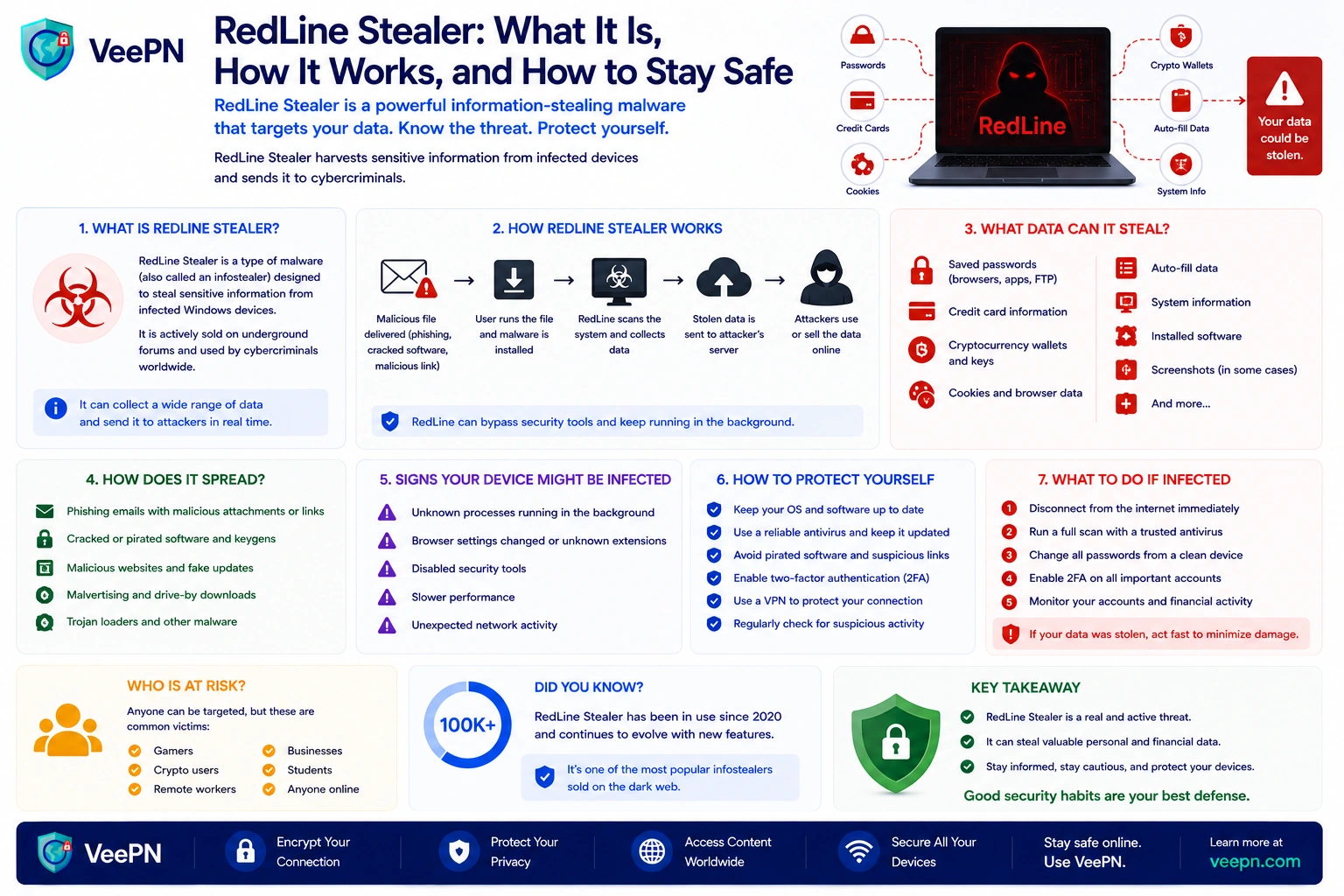
You do not always notice RedLine Stealer right away. That is the problem. It usually does not lock your screen or announce itself like ransomware. Instead, it works quietly in the background, grabs what it wants, and sends it off to criminals before you realize something is wrong.
That makes RedLine Stealer malware especially nasty for ordinary users. One fake installer, one sketchy download, one convincing email, and suddenly your login credentials, browser cookies, credit card information, crypto wallets, and other sensitive information may already be gone. Near the end, we’ll also show where a VPN like VeePN can help lower the risk around these kinds of infections.
 VeePN Research Lab

 Quick Navigation
2. How RedLine Stealer malware gets initial access
3. What RedLine Stealer steals from web browsers, browser extensions, and apps
4. Why threat actors use this stealer malware for data exfiltration
5. Signs your compromised device may have RedLine malware
6. What to do right away if you suspect RedLine Stealer
7. Why VeePN helps when RedLine targets your accounts and browsing
FAQ
What RedLine Stealer is and why it still matters
RedLine Stealer is an info-stealing malware family first identified in 2020. MITRE tracks it as a malware-as-a-service operation, meaning different actors can rent or buy it instead of building their own tool. That low barrier is a big reason it spread so widely.
What makes it more serious than a one-off infection is where the stolen data goes. The logs end up on dark-web forums and with Initial Access Brokers who resell credentials for follow-on attacks, so the first theft is usually just the opening move.
That chain matters to individuals and companies alike: a saved password from a personal laptop can become the initial access into work email, VPN portals, admin dashboards, or cloud apps when the same account, session, or browser sync touches both worlds.
How RedLine Stealer malware gets initial access
Almost nobody goes looking for RedLine. People are tricked into launching it because it looks normal, useful, or urgent, which is why distribution is such a big part of the story.
Phishing emails are still one of the easiest doors in
In March 2020, Proofpoint spotted one of the earliest RedLine email waves: a lure posing as coronavirus research that pushed a fake Folding@home-style app, mostly hitting US healthcare and manufacturing targets.
The trick hasn’t changed much since. Phishing emails, fake invoices, fake updates, and urgent “security” prompts still deliver malicious attachments, booby-trapped links, or a fake installer that drops the payload onto the device.
Fake tools, game cheats, and malicious websites do a lot of the work now
A 2025 advisory from Singapore’s Cyber Security Agency warned that RedLine had been seen on GitHub disguised as game-cheating tools, and inside apps pretending to be antivirus software or an OS update.
That’s the part people underestimate: a file doesn’t need to look evil to be dangerous. It can arrive as an MSI installer, a ZIP, a crack, a cheat, or a “free utility” pushed through malicious sites and ads. Kroll documented cases where users hunting for harmless tools were steered to pages serving RedLine as fake PDF software.
Browser extensions can also be part of the trap
A 2023 Stormshield investigation began with a malicious Chrome extension and uncovered a wider RedLine campaign using public repositories, loaders, and a harmful add-on to monitor browser activity, read files, grab cookies, and steal from wallet extensions.
People simply trust the browser too much, saving passwords, staying logged into everything, installing add-ons without reading permissions. One malicious extension can see far more than most users expect, which is why storing passwords in the browser remains a weak habit.
What RedLine Stealer steals from web browsers, browser extensions, and apps
Once it runs, RedLine is built for fast collection. It doesn’t chase a single password. It assembles a package of victim data that criminals can sell, reuse, or build on.
It targets the data people leave sitting in web browsers
Proofpoint and Kroll both describe RedLine pulling passwords, saved credentials, cookies, autocomplete data, and card details from browsers. That means a victim can lose both raw passwords and the active session data attackers use to slip into accounts without starting from zero.
One browser infection can snowball fast: if it grabs logins for email, banking, shopping, work tools, and social all at once, the attacker has many ways in. Even with MFA enabled, stolen session data can make cleanup urgent.
It also goes after apps, wallets, files, and system details
RedLine isn’t limited to browser passwords. It can collect from FTP clients, chat apps, and wallet files, while profiling the machine, IP address, location, hardware, installed security software, even the system default language.
That profiling helps attackers decide what to do next. A machine with work accounts, crypto tools, or useful network access is worth more than a random home PC, so the theft is also about choosing the best path for deeper abuse.
It can do more than simple theft
RedLine has also been seen downloading extra files for later-stage activity. Proofpoint documented downloader features, and Kroll advised that if RedLine ran on a machine, defenders should assume local credentials were compromised and more payloads could follow. Some campaigns add evasion: McAfee reported a 2024 variant using Lua bytecode, while Stormshield saw samples checking for antivirus or virtual machines and using scheduled tasks for persistence.
Why threat actors use this stealer malware for data exfiltration
This is where RedLine becomes more than a nuisance: it turns infected machines into sellable inventory. Logs full of stolen credentials, tokens, and device details get pushed into criminal markets and reused by actors who had nothing to do with the original infection.
Kroll notes infostealer logs are a major part of the Initial Access Broker market, and that ransomware groups often use those valid accounts to gain a foothold in company networks. So when people ask whether a password stealer is “serious enough,” the answer is yes. It usually sits upstream of account takeovers, fraud, and much bigger intrusions.
There’s a concrete example: on October 28, 2024, the Dutch National Police and partners disrupted the infrastructure behind RedLine and META in Operation Magnus, which had hit millions of victims, and took down the Telegram channels offering the service. A major hit, but older builds and already-circulating logs keep the damage going long after a takedown.
Signs your compromised device may have RedLine malware
Most infostealer infections are quiet, so the clues are usually indirect, not a dramatic crash, but accounts and sessions behaving strangely.
- Unexpected account activity. New logins, unfamiliar session alerts, or password-reset emails you didn’t request. With RedLine the problem is rarely one account. It’s many at once, because the malware grabs whatever is already stored on the device.
- Browser sessions suddenly feel “wrong.” Getting logged out, new extension behavior, or cookie oddness after a fake download or add-on install fits the way these campaigns abuse browsers and extensions.
- Security tools act oddly. Because some samples hunt for AV or use stealth tricks, disabled scans, blocked updates, or strange behavior from your security software shouldn’t be ignored.
- You recently ran something you shouldn’t have trusted. A fake converter, sketchy update, pirated app, cheat pack, or “free” utility from a search result is the classic setup, assume a problem before visible symptoms appear.
What to do right away if you suspect RedLine Stealer
Don’t panic, move fast, in the right order. With an infostealer, the worst mistake is assuming it only touched one app.
- Run a full scan, not a quick one. A full system scan gives a better chance of catching the actual infection and any leftovers.
- Change passwords from a different, clean device. Reset important passwords on another device, start with email, banking, work, and anything tied to money or identity.
- Review bank and card activity. RedLine steals financial data, so check recent transactions and act on anything unfamiliar.
- Turn on multi-factor authentication everywhere you can. Not a magic shield, but it blocks plenty of follow-on abuse when attackers only hold raw credentials.
- Stop storing passwords in the browser. Singapore’s advisory recommends an encrypted password manager instead of browser storage.
For organizations the list grows: monitor dark-web forums and Telegram for leaked data, limit privileged access, disable inactive accounts, train staff on phishing, and run EDR on endpoints. Once an infostealer touches a work machine, it’s no longer “one infected laptop.”
Why VeePN helps when RedLine targets your accounts and browsing
VeePN won’t remove RedLine from an already-infected device, but it cuts exposure around where these infections start, and adds a safety layer while you sign in and recover accounts.
- NetGuard. Most RedLine infections begin with a fake page, a malicious ad, or a poisoned download. NetGuard blocks known malicious sites, risky domains, and malware-heavy links before they load.
- Antivirus. On supported devices, real-time antivirus is another layer against the fake utilities and booby-trapped files that deliver RedLine in the first place.
- Breach Alert. If stolen credentials start circulating, you find out sooner, more time to reset passwords and lock accounts before the damage spreads.
- Encryption. When you log into sensitive accounts on public or untrusted Wi-Fi, VeePN protects that activity from interception in transit. It won’t stop a local stealer, but it closes the network side.
Want an extra layer against the conditions that surround infostealer infections? Try VeePN with a 30-day money-back guarantee.
FAQ
Yes. RedLine Stealer is built to pull data from web browsers, including passwords, browser cookies, saved credentials, and sometimes credit card information. It can also target wallet data and some browser extensions. Discover more in this article.
Start with the basics:
- run a full scan
- change important passwords on a different clean device
- review banking activity
- turn on multi-factor authentication for critical accounts
If the machine stored work logins, assume stolen credentials could affect more than one account and tell your IT team fast. Discover more in this article.


VeePN is freedom
Download VeePN Client for All Platforms
Enjoy a smooth VPN experience anywhere, anytime. No matter the device you have — phone or laptop, tablet or router — VeePN’s next-gen data protection and ultra-fast speeds will cover all of them.
Download for PC Download for Mac IOS and Android App
Want secure browsing while reading this?
See the difference for yourself - Try VeePN PRO for 3-days for $1, no risk, no pressure.
Start My $1 TrialThen VeePN PRO 1-year plan