Deutsch
  Español
  Français
  العربية
  Indonesia
  Italiano
  한국어
한국어  Nederlands
  Polski
  Português
  Türkçe
  简体中文
简体中文  ไทย
ไทย  Tiếng Việt
  Čeština
  فارسی
فارسی  Română
  Filipino
  日本語
日本語 


Are VPNs Legal in Japan? What You Need to Know Before You Connect
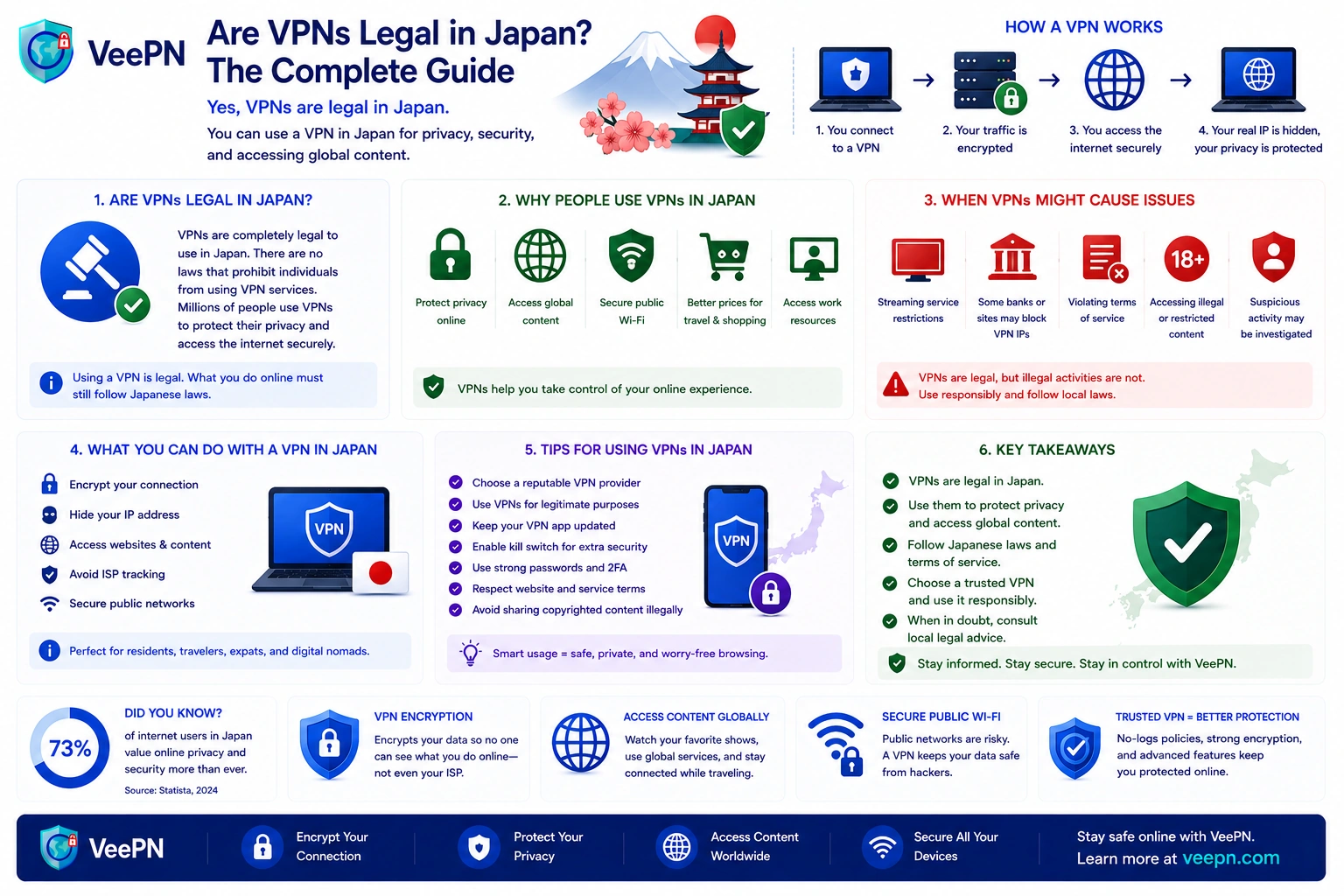
Let’s clear this up first. If you use a VPN in Japan, you are not breaking the law just because the app is turned on. A virtual private network is generally legal in Japan, and Japan still has a fairly open internet environment with few obstacles to access and no general blocking of websites.
That is why people use a VPN service there for normal reasons. They want a safer Internet connection on hotel Wi-Fi, more online privacy, or access to the accounts and services they already use at home. Japan’s privacy framework also puts real weight on protecting personal information, which is one reason privacy tools still make sense in everyday life.
But there is one line you should not blur. A VPN can protect your data. It cannot turn an illegal act into a legal one. If something breaks Japanese law, it stays illegal with or without a VPN. That is the part many people miss when they skim this topic too quickly.
 VeePN Research Lab

 Quick Navigation
Let’s clear this up first: turning on a VPN in Japan doesn’t break the law. A virtual private network is generally legal in Japan, and the country still has a fairly open internet, few access obstacles and no general website blocking.
So people use a VPN there for ordinary reasons: a safer connection on hotel Wi-Fi, more privacy, or access to the accounts and services they already use at home. Japan’s privacy framework also puts real weight on protecting personal information, which is part of why privacy tools still make sense day to day.
But one line shouldn’t be blurred. A VPN protects your data; it can’t turn an illegal act into a legal one. If something breaks Japanese law, it stays illegal with or without a VPN, the part many people miss when they skim this topic.
Are VPNs legal in Japan? The short answer is yes
They’re legal. The reality is less dramatic than some articles suggest: there’s no blanket ban on VPNs, no rule barring private users from installing VPN software, and no sign that normal VPN use draws special suspicion from the Japanese government.
What Japan cares about is the activity itself. Using a VPN for remote work, safer browsing, or private messaging is one thing; using it for piracy, fraud, or illegal gambling is another, and the VPN doesn’t clean that up. The tool is legal, the behavior still matters. Get that distinction, and the rest of this is easy.
Why people use a Japan VPN in real life
Most people aren’t hunting for a loophole. They just want a more private, less exposed way to go online.
Safer browsing on public Wi-Fi
Japan has plenty of spots where travelers and locals hop onto public Wi-Fi, especially airports and transport hubs. Japan’s Digital Agency warns that unfamiliar Wi-Fi can bring risks like eavesdropping, spoofing, and improper access to personal information. A VPN’s encrypted connection keeps your traffic harder to read on those shared networks, which matters more when you’re handling sensitive data or banking from a phone.
Accessing your usual apps and content
People travel, but their digital life travels with them, subscriptions, work tools, and familiar apps they expect to keep working. A Japanese server (or one in another country) can help you reach content that depends on location and work around some geo-restrictions: logging into local services from abroad, browsing from Japan while visiting, or checking how a regional site behaves. Usually it’s less about “beating the system” and more about keeping life normal while moving around.
A bit more privacy in everyday browsing
Plenty of people simply don’t love being visible online all the time. That’s normal, not paranoid. A VPN hides your IP address, encrypts traffic, and adds a buffer between you and whatever network you’re on. If your goal is basic security and fewer privacy headaches, it’s a sensible tool. Not magic, just sensible.
What is still illegal even if you use a VPN
This is where people get careless. The VPN isn’t the problem; the action can still be.
Piracy and illegal downloads
Japan takes copyright seriously. The Agency for Cultural Affairs says downloading illegally uploaded copyrighted works is illegal, and the rule now covers copyrighted works broadly, not just music and video. So using a VPN to grab pirated manga, films, ebooks, or software doesn’t change anything: the download itself is the legal problem. A VPN is a privacy tool, not a “do whatever you want” button.
Online gambling and similar activity
A more current example: in its 2024 Police White Paper, Japan’s National Police Agency noted rising access to overseas online casino sites from homes and described that gambling as illegal. Reaching one through a VPN doesn’t make it lawful. The pattern to remember: the government isn’t worried about the app on your phone, but about what you actually do through it.
How to choose the right VPN for Japan
Once the legal side is clear, the next question is practical, which VPN is actually worth using?
Choose a provider with strong Japanese servers and a real network
The basics matter more than the branding: reliable server locations, enough capacity, and stable performance to avoid slowdowns. If your goal is local browsing or streaming that expects a Japanese location, solid Japanese servers beat flashy ads. It’s also why a single “free VPN server” can be a trap, one server isn’t a network, and a tiny free pool feels exactly as slow as you’d expect.
Be careful with every free VPN
A free VPN sounds tempting for a short trip, but it’s where many users end up disappointed: some are painfully slow, some collect too much data, and some barely offer real privacy features. Not every free option is automatically bad, just don’t assume “free” and “safe” are the same. Check the details that affect real privacy before trusting one.
Look for privacy features that actually matter
The right VPN shouldn’t just promise privacy. It should show it. Look for a kill switch, DNS leak protection, strong encryption, and a clear no-logs policy. Those aren’t flashy extras; they’re what help when a connection drops or you’re on a network you don’t fully trust. If a VPN skips the basics, it’s hard to take the rest seriously.
Why VeePN is a practical choice for private Internet access in Japan
If your goal is straightforward private access, VeePN fits this topic because it focuses on features people actually use, not sales language.
- AES-256 encryption. The core of a safer connection. It keeps your traffic protected on the shared airport, café, and hotel Wi-Fi you’ll meet around Japan.
- IP masking. Hides your real IP and makes it easy to switch locations, useful for browsing with a Japanese IP, reducing tracking, or getting around ordinary location limits.
- Kill Switch. If the connection drops, it blocks internet access until the VPN is back, so your device doesn’t quietly reconnect unprotected.
- No Logs. VeePN says it doesn’t store browsing, DNS, or search logs, because privacy is also about what a provider keeps after the fact.
Want a simpler way to browse privately and protect your data on public Wi-Fi in Japan? Try VeePN with a 30-day money-back guarantee.
FAQ
Yes, Japan allows VPNs. The current legal status is clear enough for normal users, and a VPN in Japan is generally fine for privacy, work, travel, and safer browsing. Discover more in this article.
Using a VPN itself is not what gets people into trouble in Japan. But platforms may still block VPNs, and illegal acts like piracy or unlawful gambling remain illegal even when done through a VPN. Discover more in this article.


VeePN is freedom
Download VeePN Client for All Platforms
Enjoy a smooth VPN experience anywhere, anytime. No matter the device you have — phone or laptop, tablet or router — VeePN’s next-gen data protection and ultra-fast speeds will cover all of them.
Download for PC Download for Mac IOS and Android App
Want secure browsing while reading this?
See the difference for yourself - Try VeePN PRO for 3-days for $1, no risk, no pressure.
Start My $1 TrialThen VeePN PRO 1-year plan