Deutsch
  Español
  Français
  العربية
  Indonesia
  Italiano
  한국어
한국어  Nederlands
  Polski
  Português
  Türkçe
  简体中文
简体中文  ไทย
ไทย  Tiếng Việt
  Čeština
  فارسی
فارسی  Română
  Filipino
  日本語
日本語 


AI Scams Explained: How to Spot and Avoid Modern Fraud
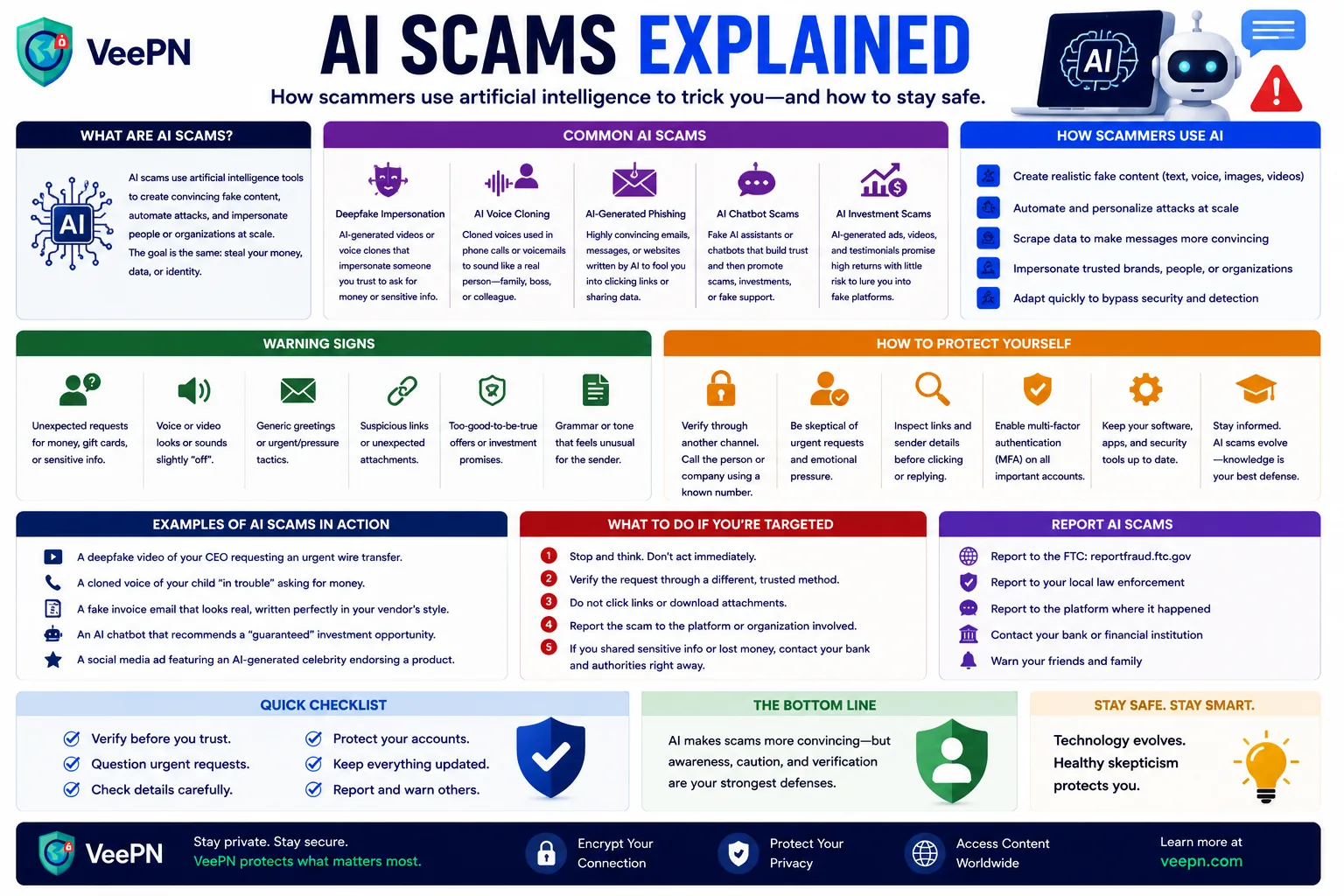
Scams have always relied on the same basic formula: create trust, create urgency, and convince someone to act before they think. What has changed is the technology.
Today, criminals can use artificial intelligence to write convincing messages, imitate voices, generate realistic images, and even appear in fake video calls. As a result, many scams that once looked suspicious can now seem surprisingly authentic.
This guide explains how modern AI-enabled scams work, the most common schemes being reported today, and the practical steps that can help you avoid becoming a victim.
 VeePN Research Lab


 Quick Navigation
Why AI Makes Scams More Convincing
Artificial intelligence has not changed the goals of scammers. It has changed how quickly and cheaply they can create convincing fraud.
AI tools can help criminals:
- Generate personalized phishing messages at scale
- Clone voices from short audio samples
- Create realistic fake images and videos
- Build convincing fake websites and online identities
- Automate conversations through chatbots and messaging apps
The result is that traditional warning signs, such as poor grammar or obviously fake messages, are no longer as reliable as they once were.
Instead of looking for technical flaws, people increasingly need to verify who they are actually communicating with.
How AI-Enabled Scams Usually Work
Most AI-assisted scams follow a familiar pattern.
- The victim receives a message, call, video, or social media contact.
- The scammer creates urgency, fear, excitement, or trust.
- The victim is pressured to send money, share sensitive information, or approve access to an account.
- Verification is discouraged or delayed.
The technology may be new, but the psychology is not.
The U.S. Federal Trade Commission warns that criminals can now clone a person’s voice from a short clip found online — see its guidance on fighting back against harmful voice cloning.
Common AI Scams to Watch For
Voice Cloning Scams
Voice cloning tools can generate a convincing imitation from a relatively short audio sample.
Scammers may call pretending to be a child, spouse, friend, or coworker who urgently needs money. The goal is usually to trigger an emotional response before the victim has time to verify the story.
If you receive an unexpected emergency call, hang up and contact the person directly using a number you already know.
AI-Generated Phishing Messages
Phishing remains one of the most effective forms of online fraud.
AI helps scammers create messages that look professional and personalized. A fake email may reference your employer, recent activity, location, or interests, making it seem more legitimate.
Common themes include:
- Password reset requests
- Suspicious login alerts
- Package delivery problems
- Banking notifications
- Fake invoices or payments
The objective is usually to steal passwords, payment information, or multi-factor authentication codes.
Deepfake Video Impersonation
Deepfake technology can generate realistic video and audio impersonations of real people.
Criminals have used deepfakes to impersonate executives, business partners, and public figures. In some cases, employees have been persuaded to authorize large financial transfers after participating in what appeared to be legitimate video meetings.
While deepfakes are not yet perfect, they are becoming increasingly difficult to identify at first glance.
Fake Investment Opportunities
Investment scams have quickly adopted AI-generated content.
Fraudsters may create fake experts, fake customer testimonials, fabricated profit screenshots, and professional-looking websites to promote cryptocurrency, trading, or investment opportunities.
A common warning sign is pressure to invest quickly or promises of unusually high returns with little risk.
Identity Theft and Synthetic Identity Fraud
Some criminals use stolen personal information directly. Others combine real and fabricated details to create synthetic identities that can be used to open accounts or bypass verification checks.
Victims often discover the problem only after unauthorized accounts, loans, or transactions appear in their name.
Signs You May Be Dealing With an AI Scam
No single clue proves that a message, call, or video is fake. The best approach is to look for multiple warning signs.
Red Flags in Messages and Calls
- Requests for passwords, verification codes, or sensitive information
- Demands for immediate action
- Pressure to keep the situation secret
- Requests for payment through gift cards, cryptocurrency, or wire transfers
- Refusal to verify identity through another channel
Red Flags in Websites
- Misspelled or unusual web addresses
- Login pages reached through unexpected links
- Repeated requests for credentials or verification codes
- Missing contact information or company details
- Poorly functioning pages or suspicious pop-ups
Whenever possible, open the company’s official website manually instead of clicking links in messages.
Good habits go a long way: keep antivirus protection active, set up a data breach alert so you know if your information leaks, and use an alternative ID to limit what you expose online.
How to Protect Yourself
You do not need advanced cybersecurity knowledge to reduce your risk. A few consistent habits can stop many scams before they succeed.
Verify Before You Act
Treat unexpected requests involving money, accounts, or sensitive information with caution.
If a message claims to come from a bank, employer, relative, or service provider, verify it using a trusted contact method before responding.
Use Multi-Factor Authentication
Multi-factor authentication (MFA) adds an additional layer of protection if a password is stolen.
Authenticator apps and hardware security keys generally provide stronger protection than SMS-based verification alone.
Limit Public Exposure
Public social media profiles can provide scammers with information for impersonation and social engineering.
Review privacy settings, remove unnecessary personal details, and think carefully about what information is publicly available.
Be Skeptical of Urgency
Many scams succeed because victims feel pressured to act immediately.
Whenever a request creates fear, panic, or excitement, pause and verify the situation independently.
Monitor Important Accounts
Regularly review financial statements, credit reports, and account activity. Early detection can significantly reduce the damage caused by fraud or identity theft.
What a VPN Can and Cannot Do
A VPN is not a defense against social engineering. It cannot determine whether a phone call, email, or video is legitimate.
However, it can help reduce some technical risks that often accompany online scams.
VeePN features that may be relevant include:
- Encrypted connections on public Wi-Fi networks
- IP address masking that limits some forms of online profiling
- Kill Switch protection if the VPN connection drops unexpectedly
- NetGuard blocking of known malicious domains
- Breach Alert notifications when credentials appear in known data breaches
- Antivirus protection on supported devices against certain malicious downloads
These tools should be viewed as supplementary protections rather than replacements for verification, strong passwords, and MFA.
Final Thoughts
AI has made scams more persuasive, but it has not changed their core objective: convincing people to trust the wrong person at the wrong moment.
Whether the threat is a cloned voice, a deepfake video, or a highly polished phishing email, the most effective defense remains the same. Verify unexpected requests, slow down decisions involving money or sensitive information, and use security tools that reduce your exposure when something slips through.
FAQ
AI scams are fraud schemes that use artificial intelligence tools to create convincing messages, cloned voices, deepfake videos, fake identities, or automated conversations designed to steal money, credentials, or personal information.
Common examples include voice-cloning emergency calls, phishing emails, deepfake impersonation scams, fake investment opportunities, and identity theft schemes.
In many cases, you cannot reliably tell from appearance or wording alone. Focus on behavior instead: unexpected requests, urgency, secrecy, payment demands, and refusal to verify identity are often stronger indicators than technical signs of AI use.
Not automatically. Modern AI tools can create realistic audio and video impersonations. If a conversation involves money, sensitive information, or unusual requests, verify the person’s identity through another trusted channel.


VeePN is freedom
Download VeePN Client for All Platforms
Enjoy a smooth VPN experience anywhere, anytime. No matter the device you have — phone or laptop, tablet or router — VeePN’s next-gen data protection and ultra-fast speeds will cover all of them.
Download for PC Download for Mac IOS and Android App
Want secure browsing while reading this?
See the difference for yourself - Try VeePN PRO for 3-days for $1, no risk, no pressure.
Start My $1 TrialThen VeePN PRO 1-year plan