Deutsch
  Español
  Français
  العربية
  Indonesia
  Italiano
  한국어
한국어  Nederlands
  Polski
  Português
  Türkçe
  简体中文
简体中文  ไทย
ไทย  Tiếng Việt
  Čeština
  فارسی
فارسی  Română
  Filipino
  日本語
日本語 


Are VPNs Legal?
 VeePN Research Lab


 Quick Navigation
‘‘Is it legal to use a VPN, or any virtual private network?’ is an essential question for anyone looking to invest in a safe and secure VPN service.If you browse online, there’s plenty of information and different articles responding to other questions including are VPNs legal in USA? or is it illegal to use a VPN for Netflix?
In most situations, VPNs illegal is not the reality, but VPN laws, VPN usage, and wider government restrictions can differ by country based on their respective privacy and content laws. One should keep in mind that in case you use VPN to cover illegal actions, it is still regarded as illegal as well.
Should you need some assurance as far as your security on the internet and using an easy and trustworthy VPN is concerned, then among VPN providers you need to look no further than VeePN. It enjoys such good features as high-grade 256-bit AES encryption, the best location, double VPN, and powerful bandwidth that is safeguarded by the network comprising 2600 servers in 85 countries.
We will now look at the issue of whether VPNs are legal or not, how restrictive VPN laws and Internet censorship laws shape the rules, and the necessary features of a good VPN.
Is it legal to use a VPN?
In general, yes is the brief answer to the question of whether using a VPN is legal or not, but this may depend on your location, your Internet access rules, or the way you use such a product. The VPNs are based on the principle of establishing tunnels to create a safer VPN connection over your Internet connection. With the help of VPN, you will be able to improve your privacy and watch various types of materials without any restrictions. It is also capable of letting you access your favorite sites without any fear of being followed up by any other companies that may be interested in accessing your precious information and bombarding you with some targeted advertisement.
Deploying a VPN is a perfectly legitimate way of behaving online to protect your privacy as many of us want to avoid unwanted attention from nosy companies, businesses, or Internet service providers. Nevertheless, one should keep in mind that there is a difference between the laws in various countries. It is also important to bear in mind that even when you are committing an illegal activity online, simply because you have set up a VPN does not mean that it is legal.
What is an illegal use of VPNs?
There are different online activities that a VPN can help conceal by masking your VPN traffic but could still be considered illegal in the eyes of the law.
The dark web is deemed by many to be a shady online underworld where nefarious behavior takes place. While it is not illegal to visit the dark web in itself, it is illegal to carry out certain actions that would be unlawful in the real world in this marketplace such as buying a gun or trading drugs.
Cyberbullying or online harassment is against the law even though a VPN can conceal your identity too. Just because a victim will find it hard to work out the identity of the perpetrator does not make this kind of behavior lawful.
You could also use a VPN to access illegal online content that does not comply with laws around copyright or intellectual property. Even though no action is normally pursued in the case of individual infringement of copyright, it is illegal and your ISP may intervene in a case considered grave enough.
Is it illegal to use a VPN for Netflix?
Different content streaming services such as Netflix or Hulu have their own policies around certain types of content depending on location.
If you are traveling and want to access your favorite show but platforms block access due to where you are, then there’s no denying this is frustrating. One of the solutions to these geo-restrictions may be the use of VPN because it may enable you to bypass VPN blocks when streaming sites put up VPN blocks based on location.
However, does the process of watching Netflix by using a VPN make it illegal? No, it is not unlawful to do it but it may go against the terms of service you have made when you created your account. So far, nobody has lost the contract with a service such as Netflix to use a VPN.
Which countries have banned or restricted VPN use?
A number of different countries across the world have banned or restricted the use of VPNs, and some allow only government-approved VPNs.This changes as the legislation and restrictions are obviously different between nation-states. The countries that have banned VPNs include:
- China
- Russia
- Belarus
- North Korea
- Uganda
- Iraq
- Turkey
- Oman
- United Arab Emirates
What happens if you get caught using VPN?
As we’ve said, using a VPN is only deemed a crime in certain countries or nations. If a company like Netflix does work out that you’re using a VPN to access geo-blocked content, then you may see a warning message telling you to stop. But that is about as far as their response will go. You should also remember that this is not against the law but does violate their terms of service which could potentially put the ongoing use of your account at risk.
A service such as Netflix could potentially file some sort of lawsuit for breaching copyright but no precedent for this has yet been set.
However, in countries where VPNs are banned, their mere use could lead to more serious repercussions.
In the United Arab Emirates, new laws state that anyone who uses a proxy server or VPN is at risk of a jail term or a fine of anything between Dh500,000-Dh2,000,000 ($136,000-$545,000) if they are found to use VPNs fraudulently. In Myanmar, the authorities are threatening VPN users with jail sentences of up to three years alongside fines of $2,800.
China’s Great Firewall means its citizens are only able to view websites approved by the authorities. This means the online experience in China is subject to great restrictions. Reportedly, a male resident was given “an unspecified administrative penalty” for bypassing this.
How do people get caught using VPN?
Using a VPN is a good method of securing your privacy over the Internet by creating a secure connection. This has the capability of concealing your IP address and not tracking your browsing.
This sounds secure but you can still be caught out when using a VPN. If you have chosen a free service, then this could put your online privacy at risk. They may have weak cybersecurity in place or even farm your data out. As their service is free, they need to generate income in other ways, including selling your precious personal details.
Should a police in vestigation target you and court order is lifted, then the authorities might visit your ISP to ask them to provide information about your connection or use logs.
In countries where VPNs are banned, it’s sensible to take the precaution of investing in a reliable VPN service. This means you’re adding an extra layer of security. Let’s look at the best features every decent VPN should possess.
Important features a reliable VPN should have
Kill Switch
A VPN creates a secure tunnel between you and your target destination on the web. However, if this connection collapses, then this tunnel disappears meaning your personal information could be made available. A good VPN will employ a Kill Switch to immediately cut off Internet traffic on all of your devices until a secure network is established once again.
Double VPN
Users tend to be connected to a VPN server when they use VPN, which is what assigns new VPN IP addresses. This way, you are able to alter your location or IP address so that whatever you are sending or getting will not be legible. The use of a double VPN is an extra level of protection that gives another level of protection.
Numerous servers
With the help of a trustful VPN, you will access a variety of various servers to ensure better security and fast connections. An excellent provider will invest in its server network and maintain it to the best capacity, which is what reliable VPN service providers do.
No logs
Any reputable VPN company will have a No-Logs policy that serves to show that it is concerned about your privacy. This will give why and what data it gathers in as straightforward and clear as feasible. As an example, in the case of VeePN, our policy states that we do not log your browsing history, your IP address, or metadata of your device. Neither do we ever give your data to any third parties.
How to test if a VPN is reliable
Before selecting a VPN, you should do your research online and look for reviews or peer recommendations on the best services. If a VPN has ever been involved in a data leak or caught selling user data, then it’s probably wise to be avoided. This usually involves free VPNs from shady free VPN providers, which are often too good to be true.
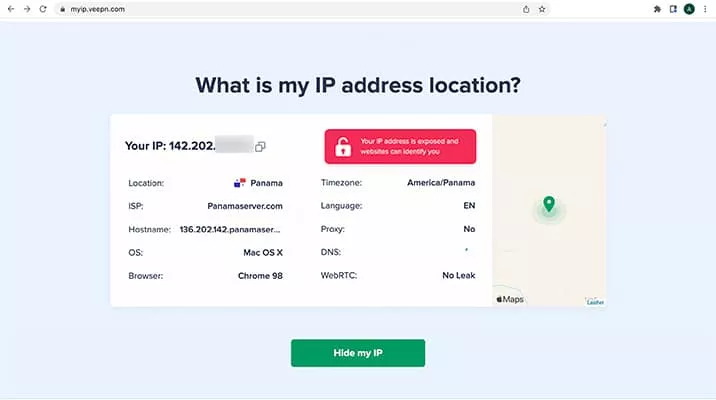
You can also test the reliability of a VPN by checking if it alters your IP address. Follow the below steps to do so:
- Make sure you are not using a VPN. Then go to https://myip.veepn.com/
- Connect to your VPN and check your IP address again
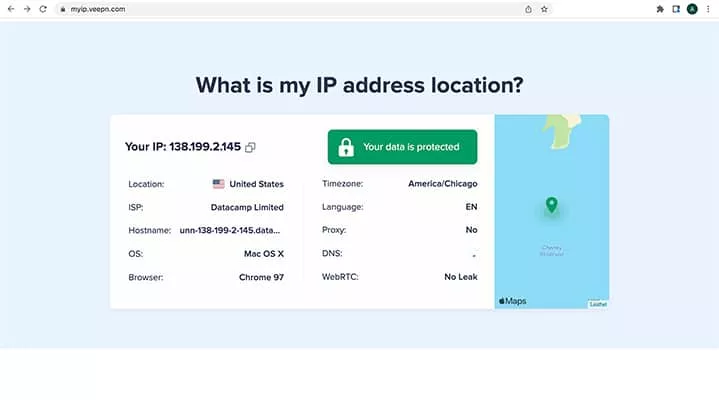
If your VPN is working effectively, then you should see a different IP address and browsing location. This is the most basic check you can use to assess the status of a VPN and whether it is working.
If you don’t check the reliability of your VPN, then you are putting your IP at risk. This is something we really recommend you avoid wherever possible.
Additional ways to safeguard your online privacy
There are additional tests you can take to protect your online privacy including with your domain name system or DNS. This is what creates our IP addresses and domain names. When using a VPN, any online traffic is usually sent to an unknown DNS server. If this doesn’t happen and your request goes to your ISP, then it’s likely that you’re suffering from a DNS leak and your information is exposed. You can test for a leak of this kind with websites including DNSLeak.com or DNSLeakTest.com.
It can also be prudent to check the security of applications using WebRTC such as Google Hangouts of Discord. This is an open-source project designed to enable peer-to-peer connections without needing any additional plugins or applications. However, when a VPN user visits a site with WebRTC enables, it means data can be transmitted outside of any encryption. A way to check if it is leaking is to verify the IP address when connected to a VPN. It should be identical and if not, then your security could be at risk.
Conclusions
So are VPNs legal to use? As we’ve seen, this depends on your location and how you are using this service. In case you are going somewhere new it may make sense to examine their laws on VPNs so that you can be certain that you are not violating their laws. In case, you would like to have the full peace of mind, it is worth spending money on a credible VPN service so that your information will be as safe as it can be.


VeePN is freedom
Download VeePN Client for All Platforms
Enjoy a smooth VPN experience anywhere, anytime. No matter the device you have — phone or laptop, tablet or router — VeePN’s next-gen data protection and ultra-fast speeds will cover all of them.
Download for PC Download for Mac IOS and Android App
Want secure browsing while reading this?
See the difference for yourself - Try VeePN PRO for 3-days for $1, no risk, no pressure.
Start My $1 TrialThen VeePN PRO 1-year plan